After a very restful night’s sleep, we ate a small breakfast at our hostel before taking off on foot to the National History Museum. Throughout the rather last-minute planning of this trip, I’d not gotten a chance to really dig in yet to the history of all of these places which is so important to understanding where they are at present.
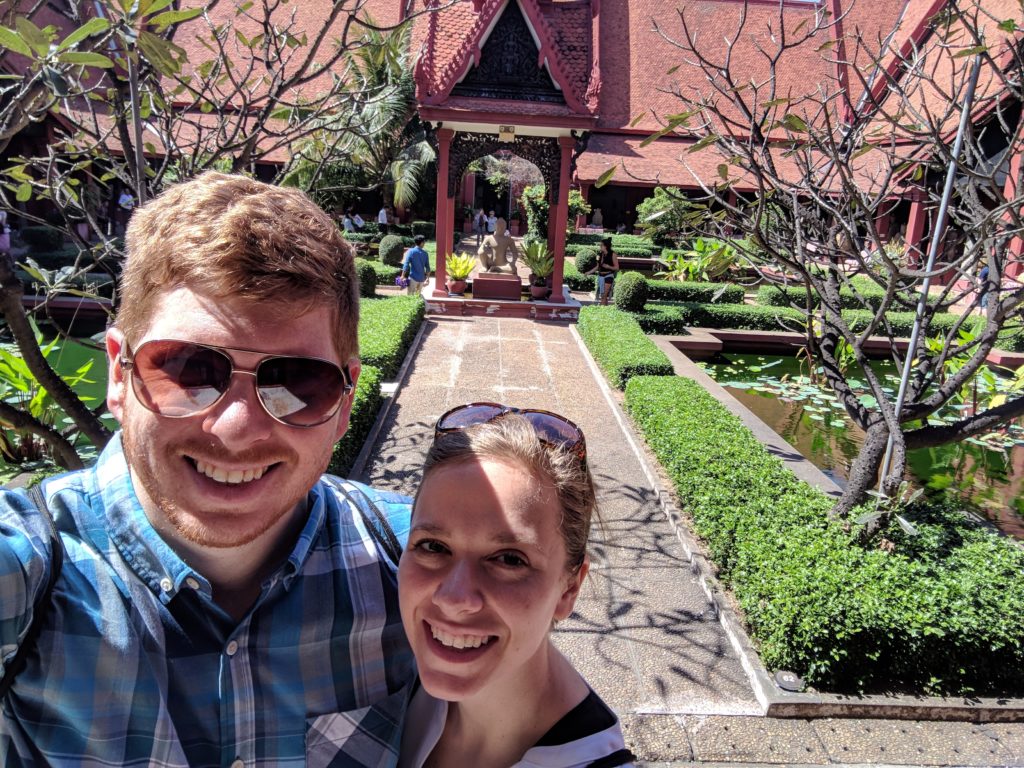
We had a very funny and sweet older woman show us around the very beautiful facility of the National History Museum. Built in 1917 and opened as a history museum in 1920 (the same year our house was built <insert head exploding emoji>), much of its contents were destroyed during the Khmer Rouge wherein anything surrounding religion was destroyed. Many items that were otherwise dislocated are just now being returned, including a set of gold jewelry which had been in a collection in the UK and was just returned in 2016.
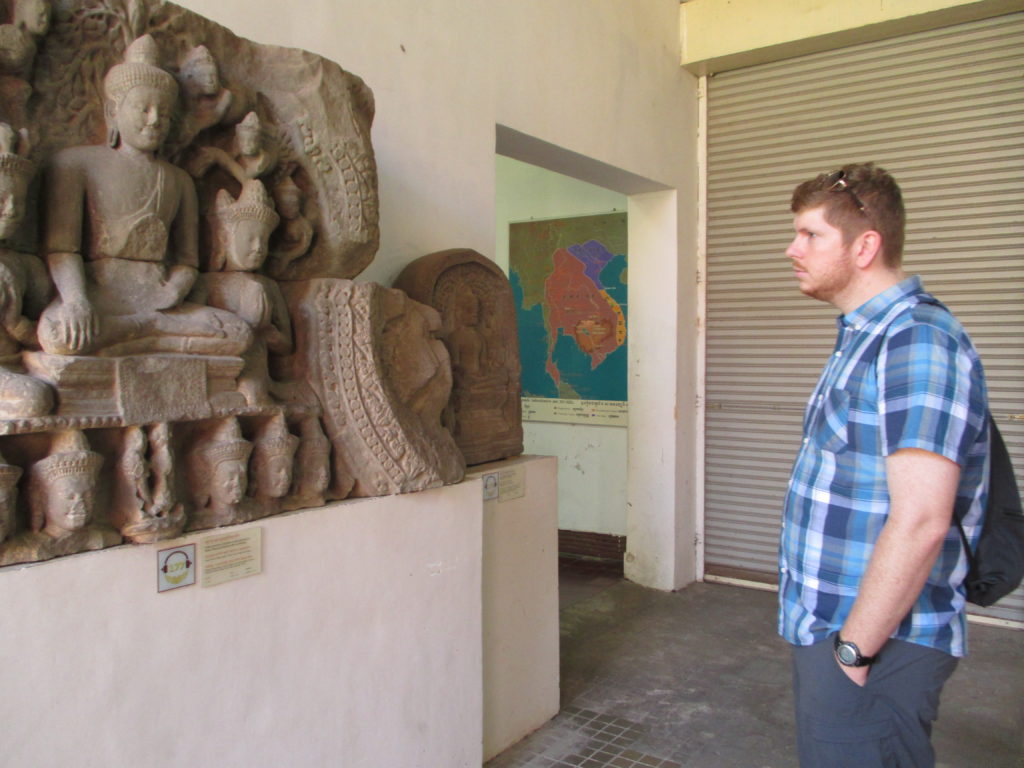
Our guide helped us better understand the history of the area, including the ebb and flow of other countries taking over in the early periods, and the importance of religion throughout the ages. While showing us a statue of Vishnu with his hand-sized wife on his arm, Ray asked “Why is she so small?” Our guide replied by just giving us a look as if to say “Well, it works for you two, doesn’t it?” She was great.
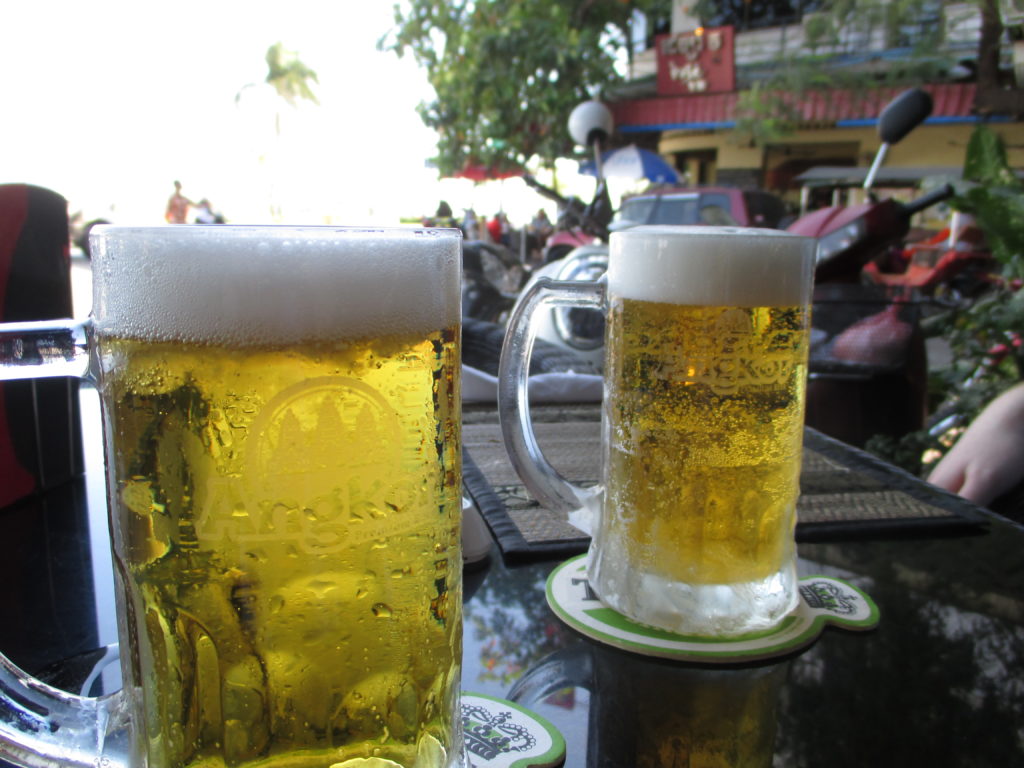
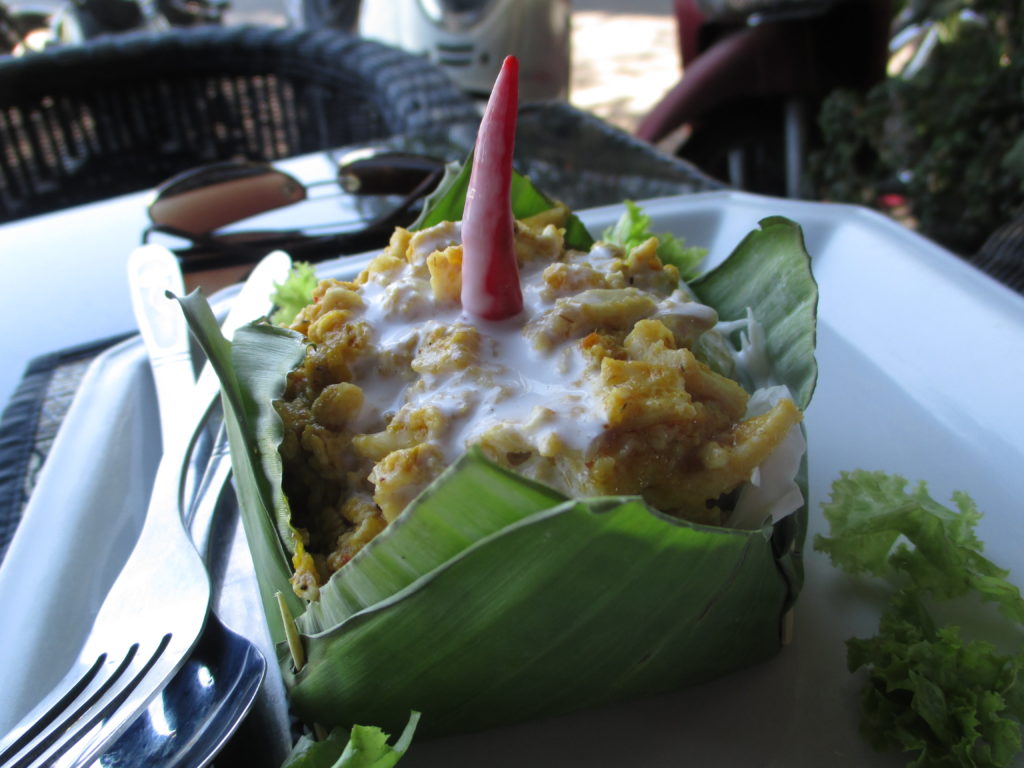
We walked back to our hostel along the broad walking lane by the river, and then stopped at a restaurant along the way that was boasting $.75 beers. How could we refuse?! 3 beers and a yummy fish amok later, we continued on our way in the hot sun.
Next, we caught a tuk tuk to Tuol Sleng. This is a museum set in an old high school which was turned into a prison and place of torture during the Khmer Rouge / Pol Pot regime. This is only one of 150 or more execution centers set up in the country during this time. Again, we had a guide who took us through the harrowing museum. She told us not only of the atrocities that occurred during the 4 years the Khmer Rouge was in power (including torturing and killing members of their own party in the final days), but also of her personal story.
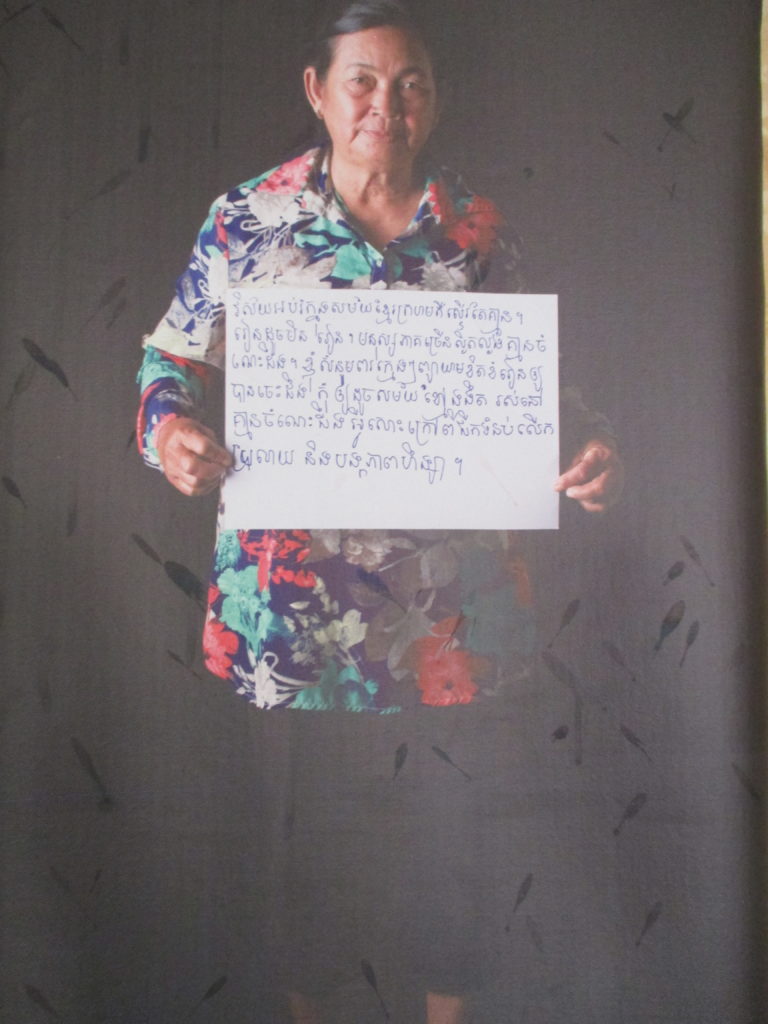
Portrait at the Museum: “Education during the Khmer Rouge period was almost none. That was the lesson, they could not educate you to learn anything. Almost everyone could not read. I suggest to the next Cambodian generations: please put more passion into learning and away from any actions that could create the dark era like that regime did when people were blinded by anger, and knew nothing besides digging canals and committing violence.”
I am currently reading First They Killed My Father, a book by Luong Ung who was 5 years old when city-dwellers were forced to leave their homes. Our guide was 9. The author of the book states at the very beginning that her story is every Cambodian’s story, and although I mentally understood what that meant, it wasn’t until I heard our guide’s startlingly similar account that I truly understood. She and her family were driven out of their home in Phnom Penh and relocated to a village in the southeastern part of Cambodia. Her father, who had been a soldier in the previous regime was killed, then her brother and sister either starved or were worked to death in a camp. Fortunately our guide and her mother were able to escape over the border into Vietnam where they lived in a refugee camp before returning to Cambodia after the fall of the Khmer Rouge in 1979.
I had expected Tuol Sleng to be really gruesome and heart-wrenching. And though it was those things, it was also very simple and matter of fact: here’s what happened. I was struck by so many things during our visit: the portraits of the impossibly young Khmer Rouge soldiers who had been “recruited” (forced to serve) from rural areas; the fact that some of the people who had governed during this period still hold positions of power today; the fact that Pol Pot was never captured or punished; that many of the higher-ups are still waiting to be put on trial. But one of the things that really struck me was that a group of maoists from Sweden, after hearing reports of the atrocities from refugees, were allowed to come in during the height of the regime (Pol Pot, despite his insistence that influence from other countries was dangerous, still needed money from outside sources). Pol Pot wined and dined them, brought them to pre-determined locations, and sent them on their way. The Swedes – this group in particular being sympathetic to the communist agenda – reported that everything was just fine! Everyone we saw was smiling! I only saw maybe four guns the whole time. This report stifled any help for the people of Cambodia from the outside world. Thankfully, the Vietnamese believed the refugees and worked to stop the regime by April 1979.
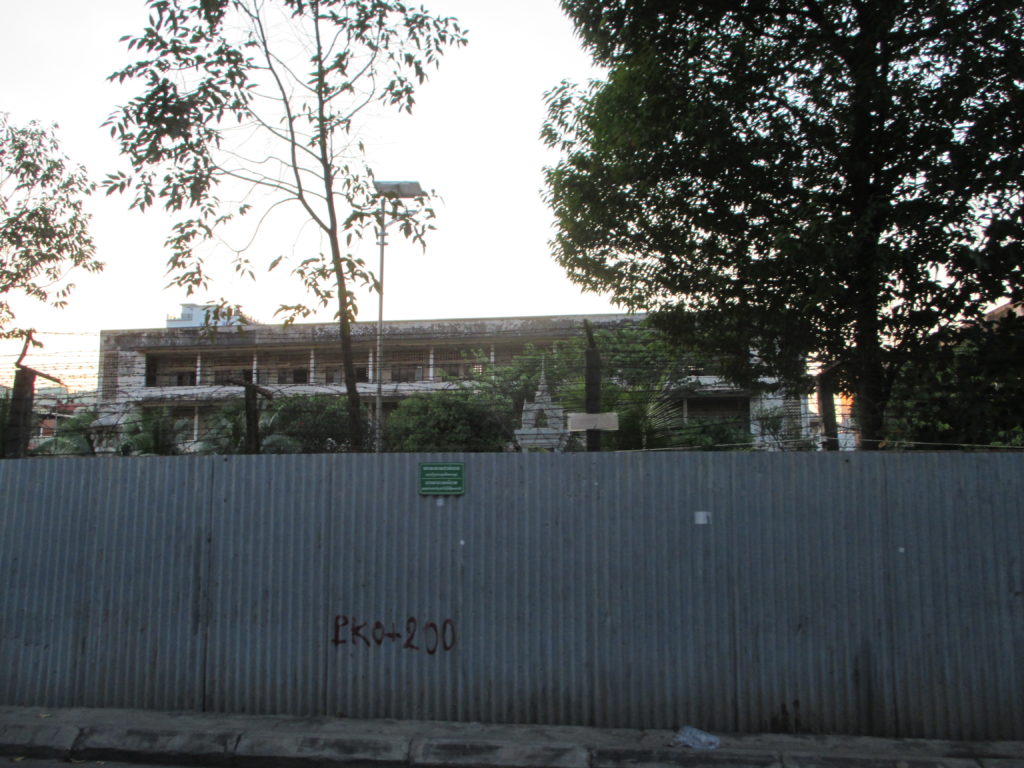
Quote from one of the exhibitions: “When the Pol Pot regime was driven from power by Vietnam in 1979, evidence of murder and execution began to be revealed to the world. Despite this, the world doubted the evidence for a considerable period of time. The perpetrators were even allowed to represent their country in the UN twelve years after the first mass graves were opened. The world has turned its eyes away a number of times during some of the 20th century’s worst catastrophes: Armenia, the Nazis genocide, Rwanda, Darfur – the list goes on. Is it possible for us to learn to see sooner the next time a catastrophe is occurring?”
Only seven people were found alive at Tuol Sleng when the Vietnamese arrived. One of them was an artist who, in the years following his release, took it upon himself to paint what had happened in Tuol Sleng. I was so shocked to hear that many people – many Americans – do not know (or worse yet, do not believe) what happened during this time. Knowing that, as we took our tuk tuk home, nearly everyone we passed had lost someone during that time – a quarter of the population decimated – gave me a renewed admiration and respect for the resilient Cambodian people.
This evening we ate a most delicious dinner at Romdeng, a restaurant that trains former street children and marginalized youth to work in the hospitality industry. For drinks we had Red Tea Bourbon with Kaffir Lime (Ray) and Honey Rice Liquor with Lime, Pineapple, and Orange Juice (me). For food, we had Smoked Duck Breast Lapp with Pumpkin, Orange, Chili, and Toasted Rice (Ray) and Rice Noodle Salad with Lotus Seeds and Mushroom Coriander Spring Rolls (me) with a baguette with Lime Coriander Butter to share. It was simply wonderful.
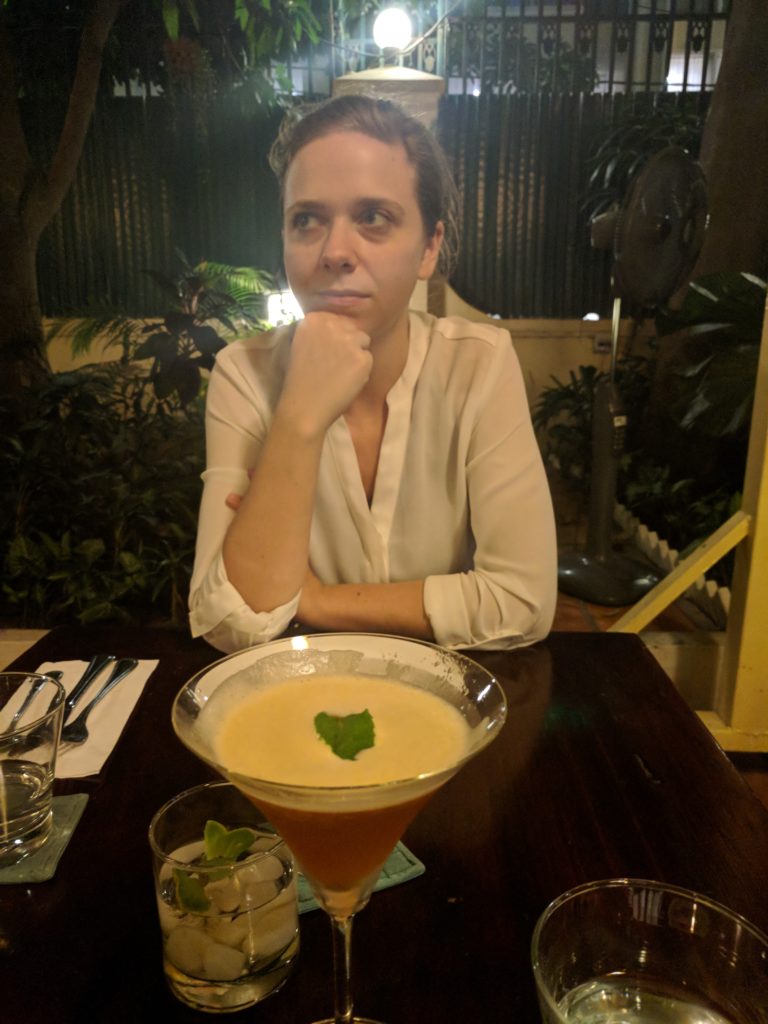
Now we are in our comfy dorm getting everything packed for our early-morning boat ride to Siem Reap!
Wow… what suffering and loss! I cannot even imagine. Thank you for sharing in such excellent detail, Jess. This trip has already been educational, and you’ve only just begun. It’s great to hear all about the food/drinks you are trying, also. It looks like the weather is warm and sunny so far? Also sounds like your accommodations are very adequate as well! Nothing new here… other than ice/snow and back to below 0 mornings! keep up the sharing 🙂 🙂