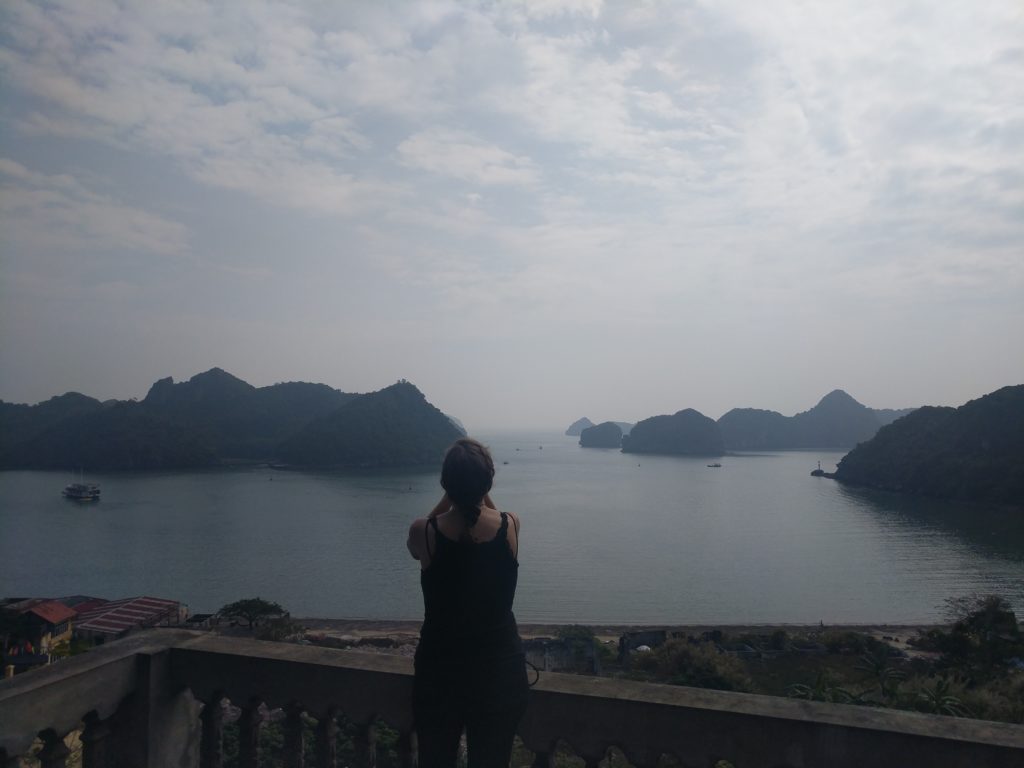
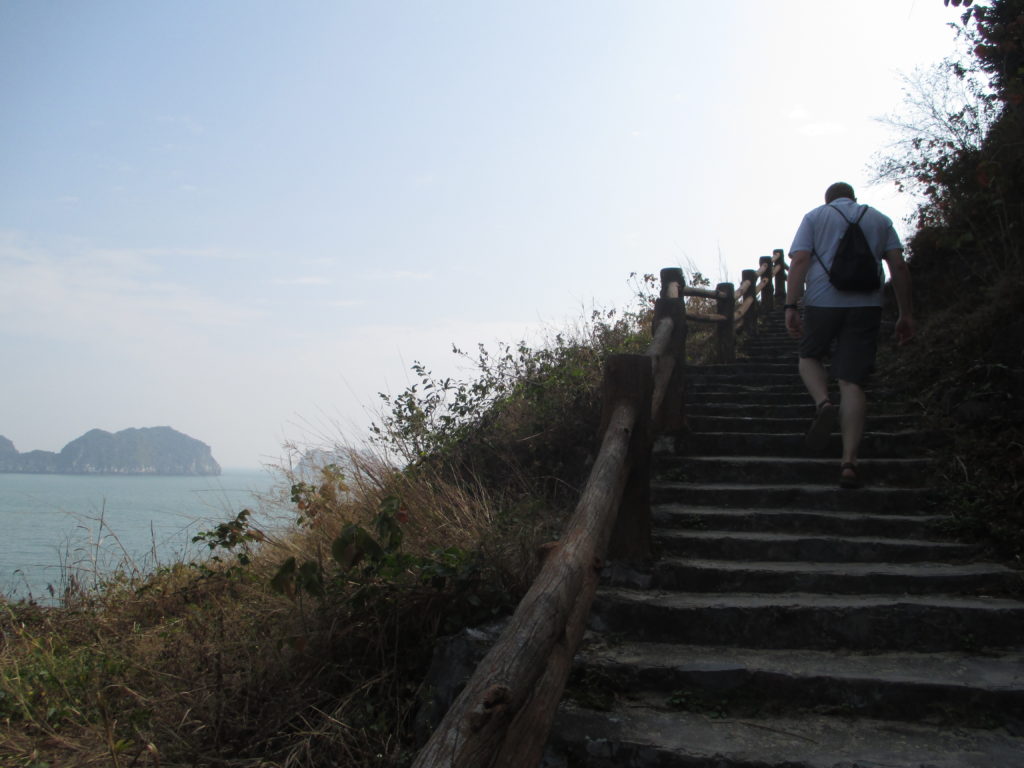
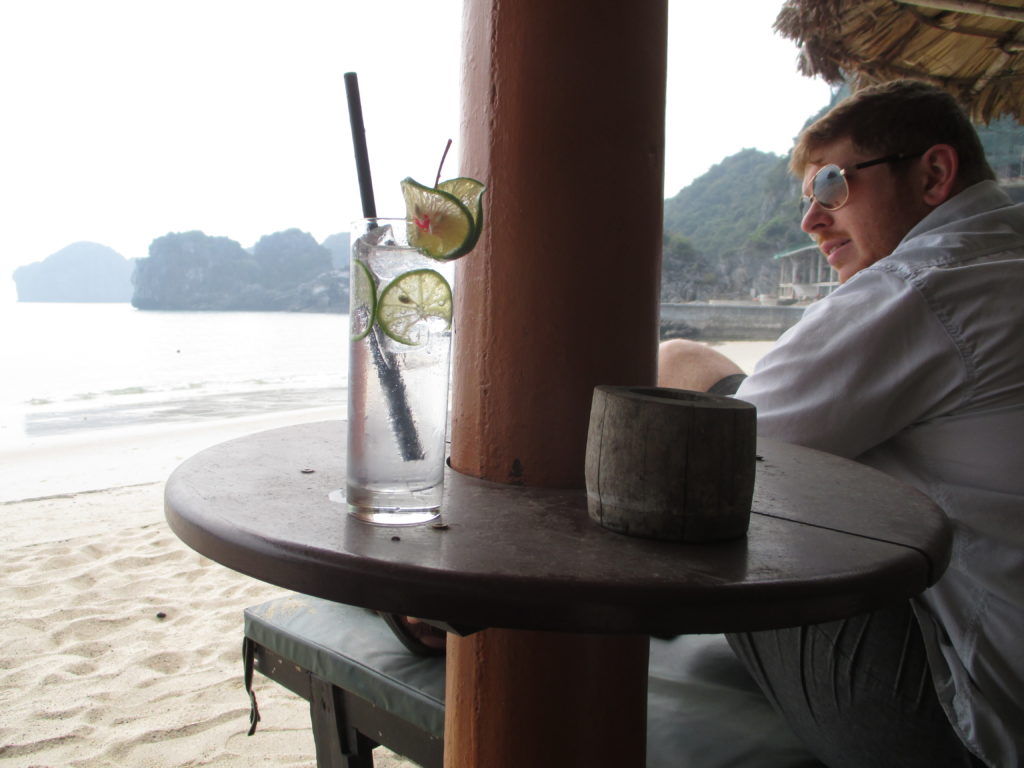
Things I didn’t know to be thankful for

2018 Southeast Asia

We sometimes joke that our vacations are often more work than play; that we tend to spend more time digging in, walking around, and trying to learn than just kicking back and relaxing. But the more I travel the harder I find it to “vacation” – especially when traveling in places very different from what you are used to. It seems somewhat irresponsible to just parachute into a place and order drinks from a local without any understanding of where they are coming from.

On this trip I had a number of realizations of things I have long taken for granted. Things that, through this trip, I now have a renewed appreciation for as well as a more nuanced understanding of how fortunate/lucky/privileged I am to have at my fingertips back home:

* Hot Water: This was a question mark at each place we stayed. Sometimes they had it, sometimes they didn’t, and sometimes they had it for a couple seconds and then nothing. I have to assume that if it is so hit or miss in places that are busy and making money, it is also a real issue in individual homes.

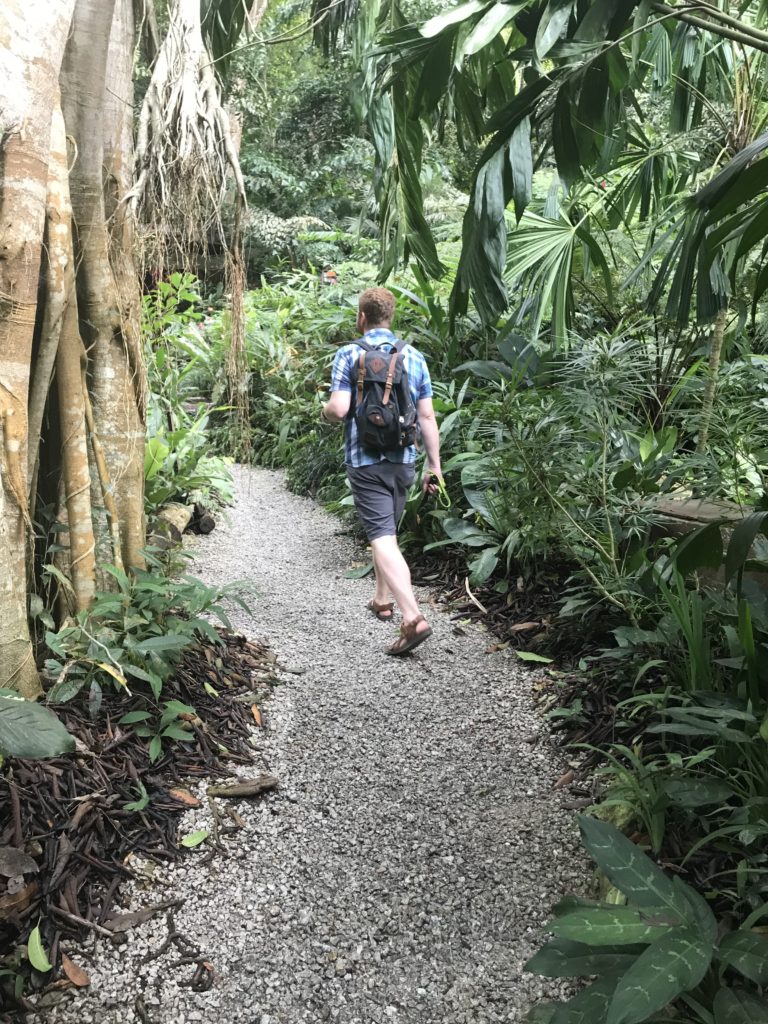
* A Shelter: Speaking of homes, I am grateful to be able to come home to a roof over my head and walls to keep out the cold. We passed countless lean-to’s and similar housing situations on our trip. I initially thought: well, the weather is so warm, maybe it just makes more sense to save money in this way. It wasn’t until asking Blake one morning how he slept and he replied, “Well, it gets pretty cold at night” that I realized that it may be less of a choice than I’d optimistically wanted to believe.

* Clean Tap Water: In nearly every place we were, the tap water was not safe to drink. Not only did this exacerbate an already overwhelming pollution issue (everyone-local and tourist alike – having to buy bottled water), but it also made me wonder what you do if you can’t afford to buy bottled water?

* Free Time / 8 Hour Days: Every local we encountered, from hotel staff to drivers to tour guides worked all. the. time. Our elephant guide drove Uber at night. Our outdoor adventure guide in Vietnam started our tour at 7am and was still serving food in the hostel restaurant as we were headed to bed. The front desk at nearly every place was manned day and night by the same people. I am thankful for labor regulations in the US.

* Minimum Wage: Along the same lines, I imagine the reason these folks were working so much is that they didn’t make a ton of money, so working more = being able to survive better and, in many cases, support their families.

* Safety Regulations: We chose the boat to Siem Reap that we did because it was the only one that provided life jackets. In most places, the road situation- for cars, pedestrians, motorcycles and buses alike – was a free for all.  It made me grateful for the invisible luxury of safety regulations. Especially when you throw in the wildcard of [often intoxicated] tourists.

* Sidewalks: With the exception of Singapore, none of the places we visited had sidewalks just for pedestrians (sometimes they doubled as extensions of shops and you had to navigate around them). We – and everyone else – spent most of our traveling time as pedestrians walking in traffic. Thinking about shoveling our corner lot back home feels more important now.

* Coughing Customs: From day one, we (with our “I can’t get sick!” radars on full blast) were shocked at the sheer number of people who didn’t even attempt to cover their coughs and sneezes.

* Personal Space in Public Places: One of my pet peeves in general is when individuals lack a sense of space (bumping into people, standing in others’ line of vision, etc). However, I had a bit of an epiphany on this trip that, if you are from a busy place (such as Tokyo or NYC) where people are always in your personal space, you must HAVE to turn off the “bubble” or you’d go nuts.

* Familiarity with a Place / Space: Anyone will tell you, I’m a planner. But when traveling, things don’t always go as planned. I’ve never in my life had so many close-your-eyes-and-jump moments. Should we get on that bus when we need to get on a boat? Should we accept this stranger’s offer of a ride? Are there actually guides at this attraction or is this a scam? I think it’s taught me 1) sometimes the best and most surprising things can come from these unplanned moments, and 2) overall, people are trustworthy and legitimately WANT to help.

* That I Know English: I am so incredibly fortunate that English is my first language. Everywhere we went, signs were on English and/or there was someone who spoke English. Even fellow travelers from Germany, France, etc. had to know English to get around. As a native English speaker, my travel horizons are endless and I get to be immensely lazy in my language learning.

The following are much more tribal things, but things a have a renewed appreciation for nonetheless.

* WiFi / Fast Internet: Oh man, is it challenging to navigate, figure out what to do, answer questions, and get transportation without WiFi in public! Very grateful for that as well as for fast internet (I spent SO many hours trying to upload photos …)

* Shower curtains: Not sure why, but with one exception, all of our shower heads were just IN the bathroom with no separation, so anytime a person showered, the entire bathroom would be soaked for the next person. I’ll be glad to have a separate shower area again!

* Price tags: Especially in Vietnam, prices simply weren’t listed. It was surprisingly nice when we got to Thailand to be able to see how much something cost before approaching the vendor.

* Pockets: I’ve started calling Ray my walking pocket. I’m not the first, nor will I be the last woman to complain about the sheer lack of pockets in women’s clothing. Never had this been more apparent. Ray had to hold my phone, camera, ID, money, and umbrella on a daily basis. Thankfully, he was a good sport about it, but I really should have had them install pockets in all my garments when we were in Hoi An!
Singapore | Day .5

2018 Southeast Asia

Our transit to and through the airport in Penang went smoothly, despite our slight worry that our bags might get weighed again (I put on two pairs of pants and five shirts for nothing!). Our arrival in Singapore was equally smooth, but we’re beginning to have anxiety flashbacks knowing that Japan Air (our carrier to the US tomorrow) was not present at the time we were there. But we were reassured that they’ll be there starting three hours before our flight tomorrow evening.

We took an Uber from the airport to our hotel and got a really lovely driver who told us about himself (“Made in Singapore!”) and an overview of the city-state that he clearly loved: It’s a democracy, but with a figurehead president, it’s primarily Chinese and Muslim/Malay, and there’s lots of good food. On his recommendation, after checking into our hotel, we walked down to a Chinese place to try “Chicken Rice” which we couldn’t find on the menu, so ordered some rice and chicken and pretended we knew what we were doing.

We then took another Uber into the heart of the city. Our driver – who also had an apparent love for Singapore – told us we were staying in the wrong area as it was not within walking distance of the sights. We told him the hotels were too expensive there 🙂

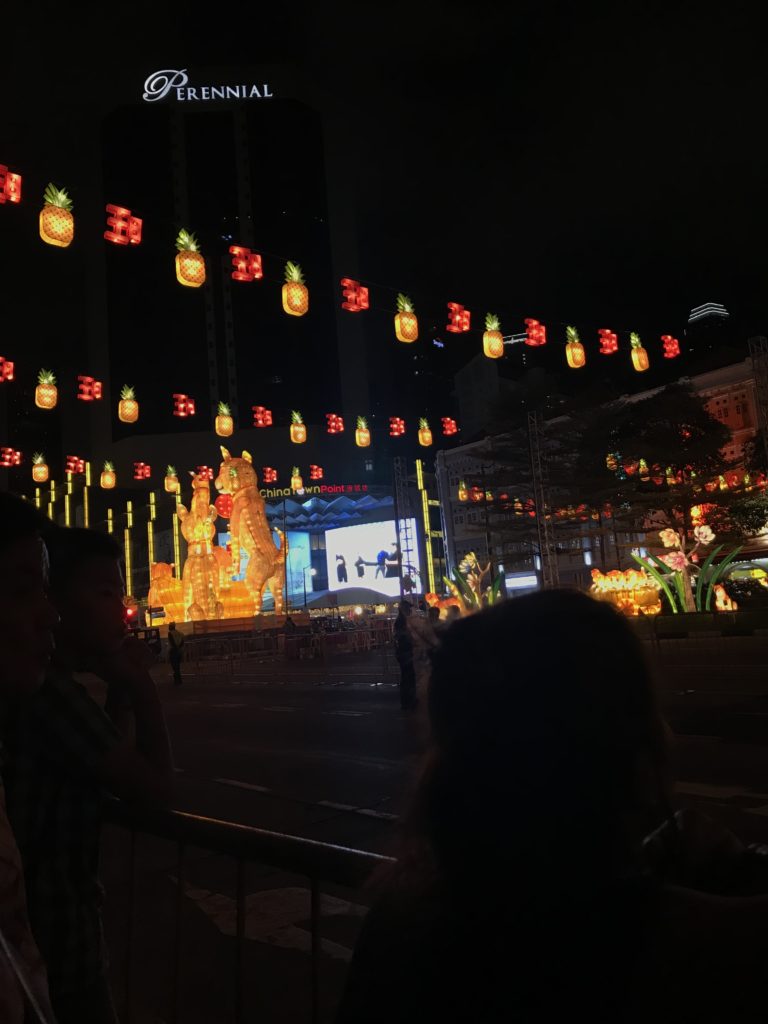
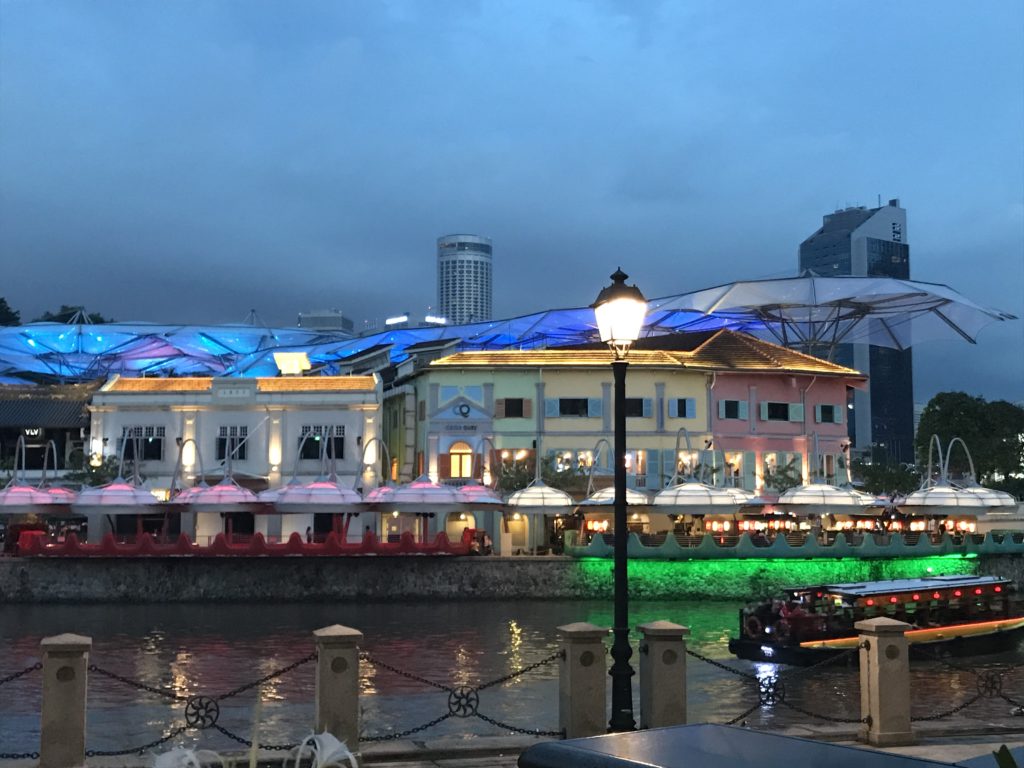
Ray and I have been noticing how we unintentionally made our way, throughout this trip, from the least developed and least expensive countries to the most developed and most expensive. Our driver remarked that Singapore was a mini-America, and I have to say he’s not wrong. Although, despite the high-rise buildings and luxury hotels, there’s also a kitchy playful vibe that is distinctly Singapore.

Classical architecture, skyscrapers, and kitschy lit-up flowers encapsulate the multiple identities in Singapore

Classical architecture, skyscrapers, and kitschy lit-up giant flowers encapsulate the multiple identities in Singapore

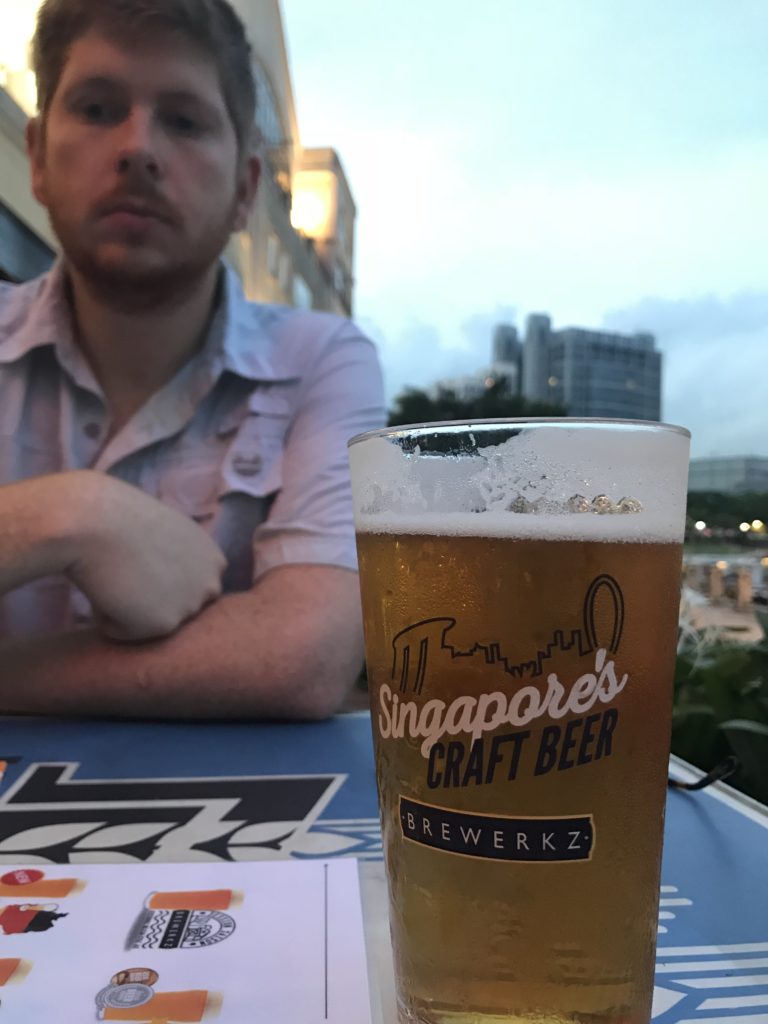
We walked around Clark Quay, a very touristy and active area, stopping for a flight of Singapore-made beers on the Singapore River.

2DBFDF87-328C-4202-98B5-EBFC4E459F1C

We noodled around the area for a while and made our way to a bus station to pick up a 24 hour transportation card, but were told that that particular station didn’t have it and to make our way to the Chinatown station.

17AACD2A-E65F-4ABE-96D3-2488AF3A38B1

The crowd in Chinatown with giant lit up dogs (this year is “Year of the Dog”)

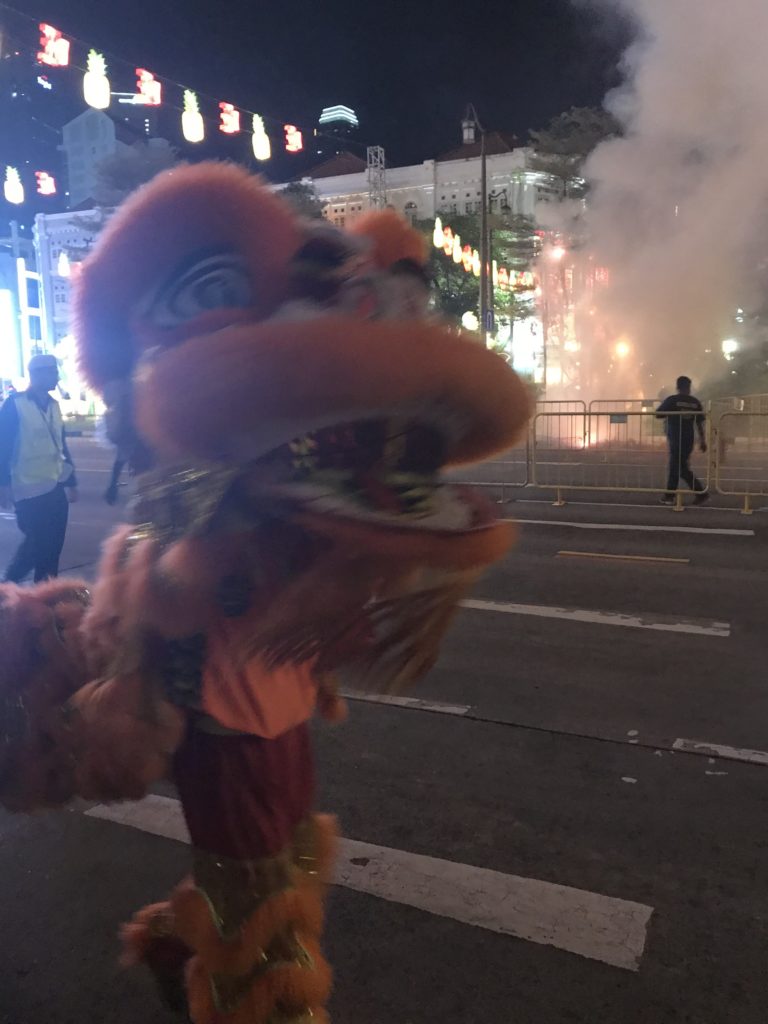
Approaching the station there was suddenly a crowd of people. Ray asked a bystander (English is everyone’s first or second language in Singapore) what was going on. This was a kickoff celebration event for Chinese New Year which happens in about two weeks. We proceeded through the crowd to the station, but couldn’t help stopping to watch some dancers, acrobats, and children dancing before a huge amount of firecrackers went off and a Chinese dragon passed us by.

BAEA62C3-FDC9-47B1-A788-A94793287E2B

Realizing the event was over and we still needed to get our tickets, we tried to leave before the majority of the crowds, but were a little too late. No worries – we got to see an aerial fireworks display through the roof of the bus terminal!

D2DB99B8-3FE4-4647-80EA-1DA2EDB16948

With our newly acquired tickets in-hand, we jumped on the train (I may have gotten smushed in the doors) back to our hotel. Picking up some ice creams and beverages on the way, we are now safely back in our hotel, looking forward to one last day squeezing the most out of our short time here before a looooong (but welcome) journey home.

Malaysia | Day 3 – In Which Malaysia Tells Us It’s Time To Go Home … Or Not

2018 Southeast Asia

After another lovely morning of tea/coffee and coconut pastries (and Ray trying hard to backwards engineer them in order to figure out how to make them back home), we set off for the bus station to catch a bus out to the northern part of the island for a “beach day.”

Our first obstacle of the day was trying to find our bus. We saw it just leaving where we thought we should pick it up, but the map by the stop showed a different location of where we should wait for it. After finding that location and three buses passing us without stopping, a local woman directed us down to the next stop. We waited there for a long time in the heat before our bus finally came.

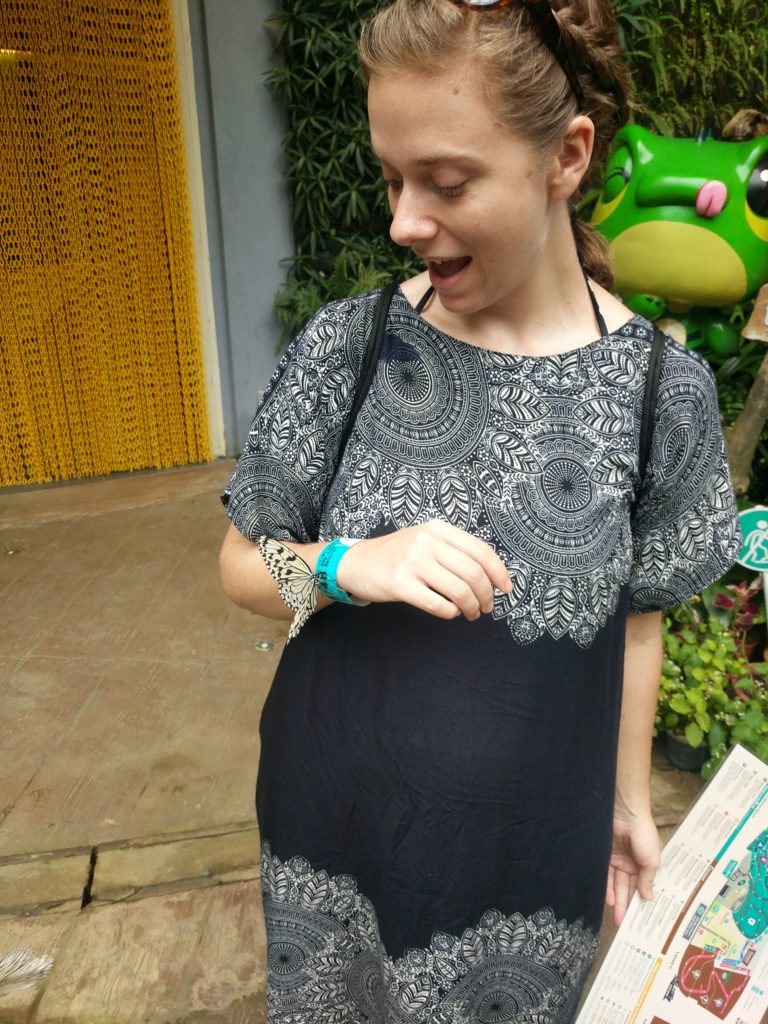
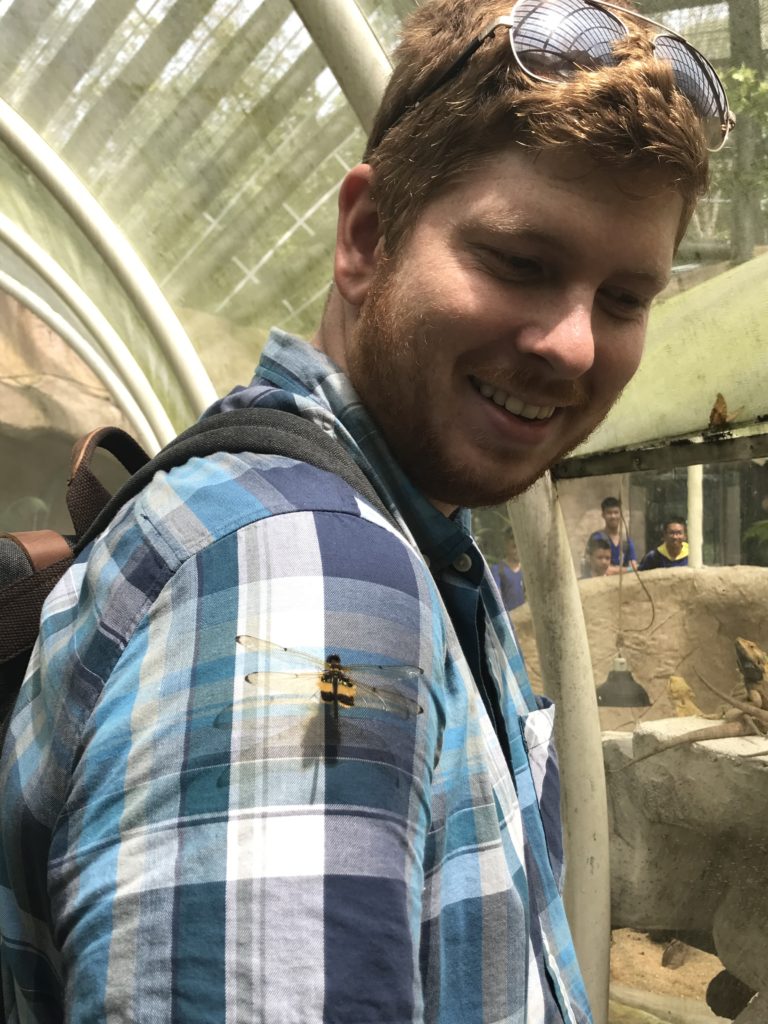
We rode until the end which was the stop for the Penang Butterfly Farm. This was a really magical place, with thousands of paper-thin butterflies swooping and fluttering everywhere you could see in this vast, open space. We saw large white butterflies that looked like washed-out monarchs, tiny orange and blue butterflies, iridescent butterflies, butterflies on fruit, butterflies on flowers, butterflies on butterflies!

2018-01-25 13.56.02

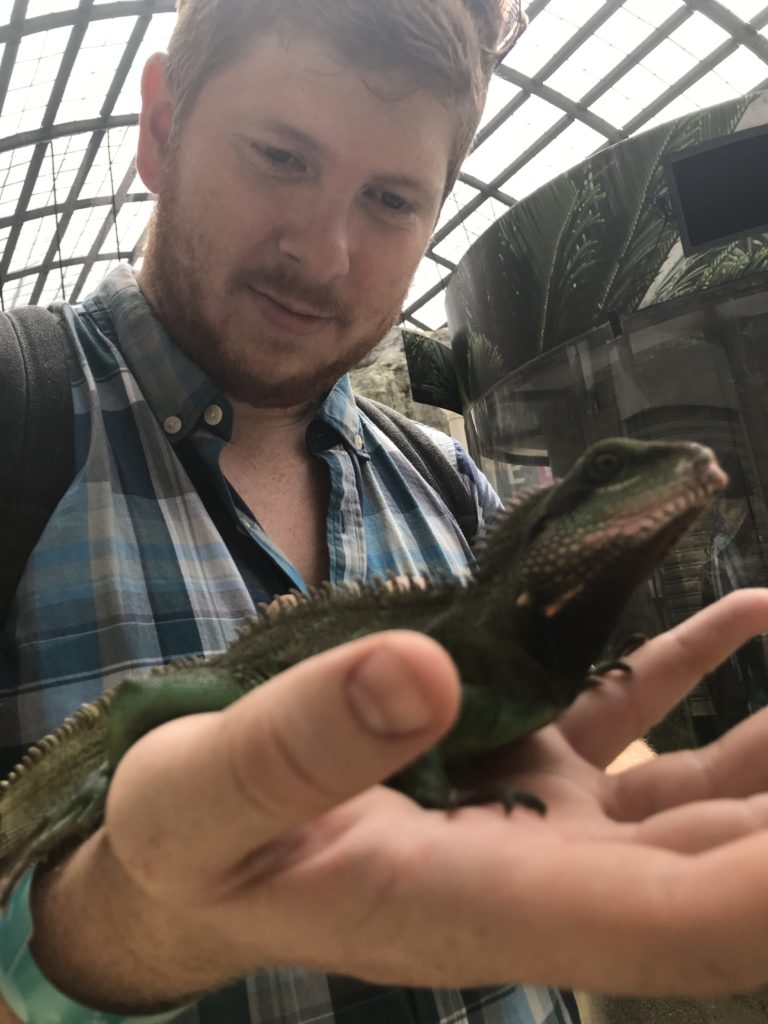
We also got to hold a lizard, see cocoons being hatched, observe snakes and giant ants and bugs and frogs, and release newly hatched butterflies.

Photo Jan 25, 2 26 36 PM Photo Jan 25, 2 21 19 PM

The second half of the exhibitions were much more education-focused and, while we learned some interesting facts (monarch butterflies’ populations have decreased dramatically in the last 20 years), they were certainly less magical than the first part. Between a silly giant bug city, strange smells, and lots of sound effects, Ray started getting claustrophobic and my tummy got rather upset.

We took a taxi over to The Spice Park. Grabbing the audio tour devices and slathering on bug repellent, we started on down the path.

Photo Jan 25, 4 32 51 PM

Before long, my tummy troubles worsened and, unfortunately I ended up spending most of our time there in the bathroom. Fortunately I had the audio tour with me, so I feel like I still learned a lot, LOL. Emerging from the park with a settled stomach and lots of bug bites, we crossed the street to a beach.

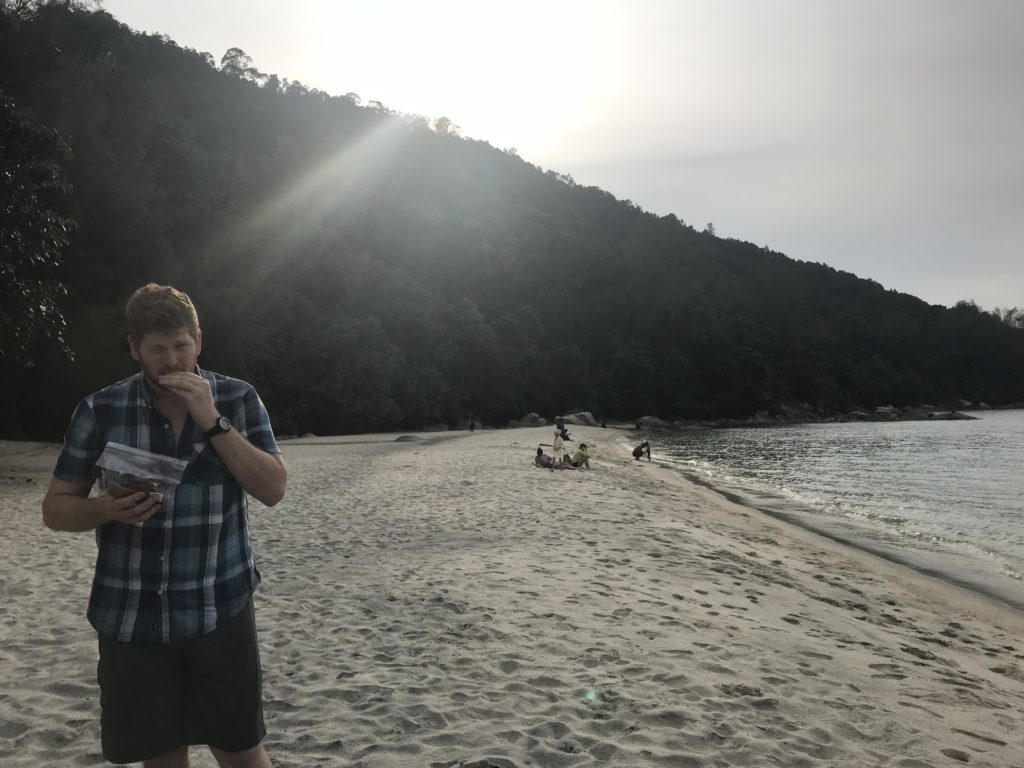
I’d really been looking forward to beach time here because it has been SO hot. The water was beautifully warm and just as I was making my way in, Ray yelped. He’d been stung by a jellyfish. He said it was worse than the last time he’d been stung in Mexico and I started worrying. What if he became paralyzed? What do I do? How do I find a hospital? Thankfully, this sting was just that – a sting – and he emerged just fine.

Ray, just prior to getting stung by a jellyfish

Ray, just prior to getting stung by a jellyfish

After the clouds rolled in, we packed up and headed to the bus stop, passing the time by watching a bunch of monkeys crossing the electrical wires from the spice park, across the street, and to a tree perch above the beach.

Video Jan 25, 6 46 32 PM

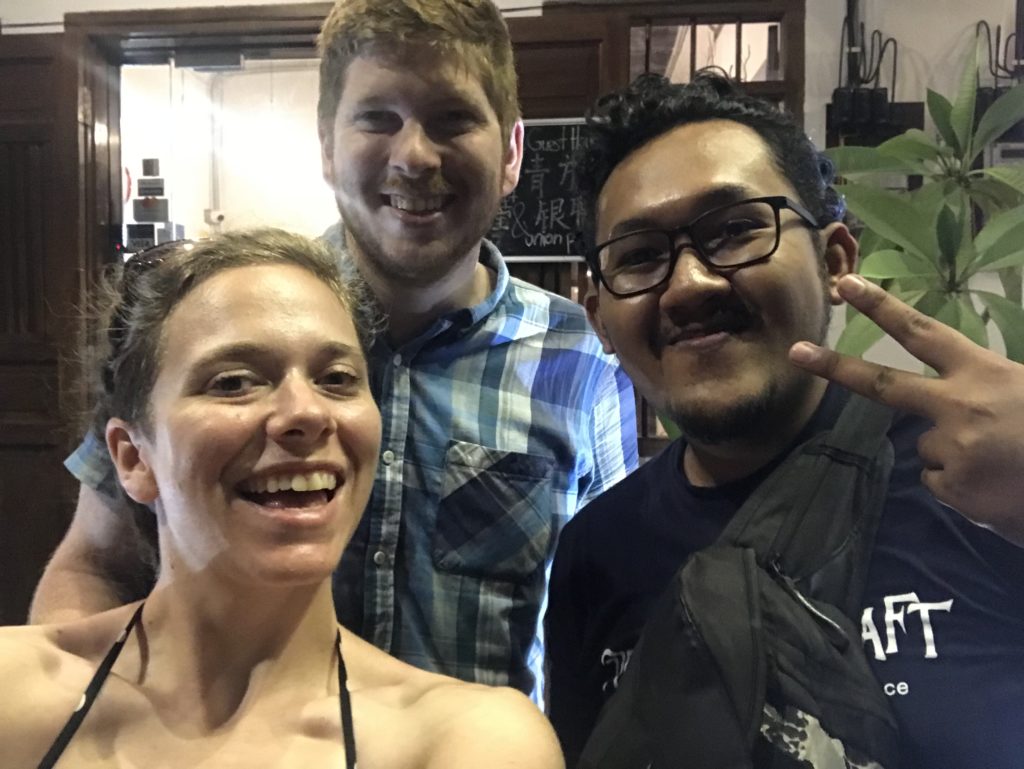
After waiting for quite a while, a friendly young guy who was parked in the lot by the bus stop asked us where we were going and if we wanted a ride. Something about his kind face told us that, although this day had had it’s drawbacks, this might be a nice turn of events. Thankfully we were right. A highlight of the day today was getting to know Bam, a young Malaysian entrepreneur who loves fishing and is visiting his grandma in Penang. He has a degree in tourism (even though that’s not his current career) and gave us a casual tour of the area. After dropping us at the door of our hostel, we took some selfies and he gave us his card. “I just love everyone I’ve met here,” Ray reflected later.

Photo Jan 25, 7 48 38 PM

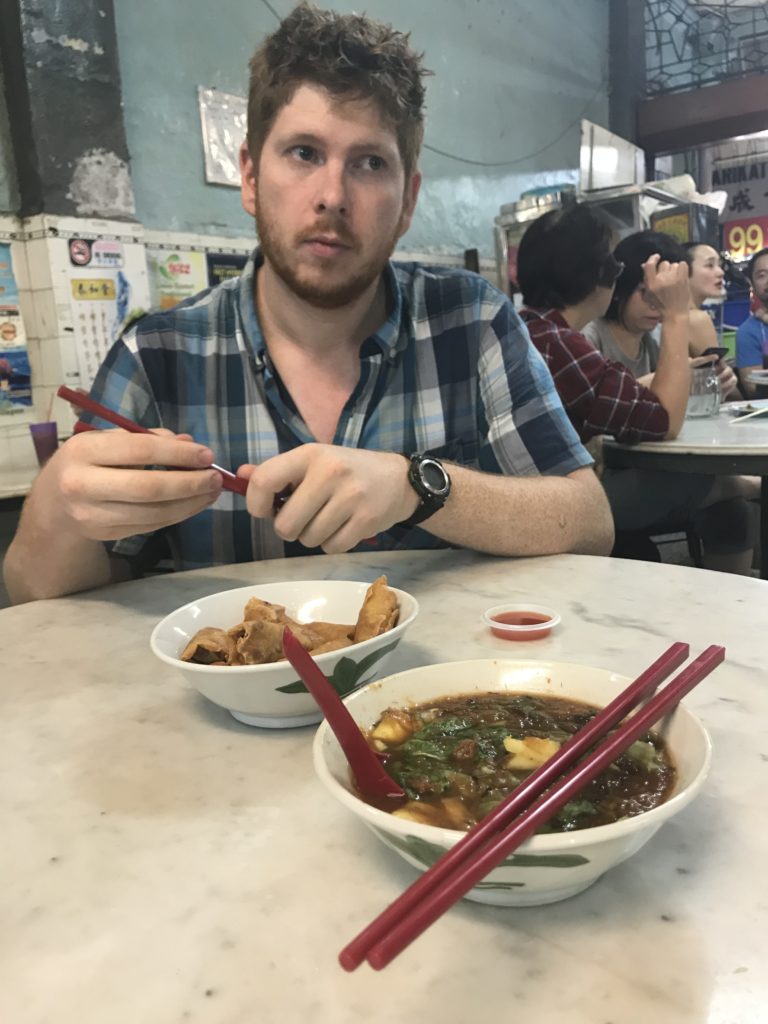
Having skipped lunch, we were quite hungry by this time and excited to try some more local specialties at the food carts on our street. We had Assam Laksa (a hot, sour noodle soup) with eggrolls, Char Koay Teow (similar to Pad Thai), some Dim Sum dumplings, and for “dessert” we had Nutmeg Juice and Soy Curd with Brown Sugar. We also made a stop at the postcard-size art store Ray’d mentioned yesterday, but found the style did not particularly mesh with ours, so made our way back home.

Photo Jan 25, 8 36 53 PM

This afternoon, Ray had realized (gasp!) this is our last day here! We’d been under the assumption that we had one more day. Fortunately, after coming back and looking at a calendar, we realized we actually do have one more day! Despite what I perceived earlier in the day as signs that Malaysia wanted us to leave, the day ended with more of those smiles and unsolicited bits of kindness that makes me excited to extend our visit – even if just for a day.

Malaysia | Day 1

2018 Southeast Asia

Originally, we’d wanted to go to Malaysia, but didn’t think we’d have time. So when booking our flight out of Thailand, we were pleased to find that tickets to Penang (an island on the Northwest corner of the country, bordering Thailand) were cheaper than flying directly to Singapore. So, here we are! And so far, we are very pleased with this turn of events.

Our flight out of Thailand was graciously unremarkable. We arrived in Penang earlier than most of our flights (11AM) and were whisked from the airport by our first female Uber driver, listening to a Malaysian radio station based out of Malacca (like Milaca!) in southern Malaysia.

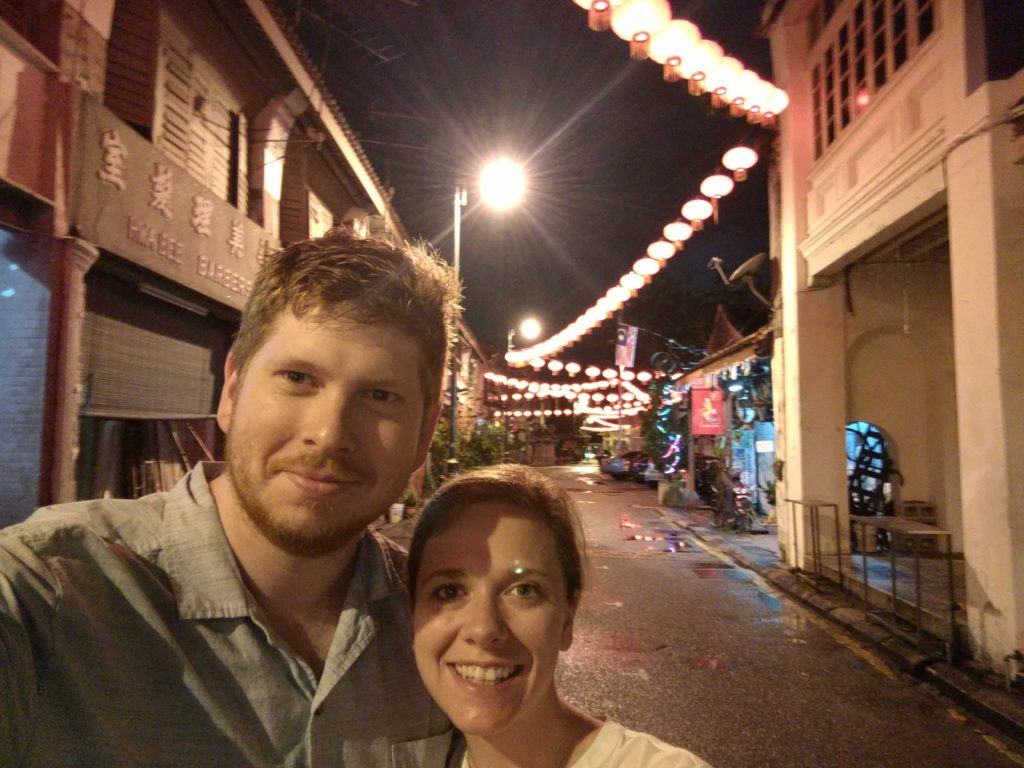
Our first impressions of this place so far: 1) everyone seems to speak remarkably good English 2) it’s a very multicultural place with a larger Muslim population than we’ve seen to date 3) its beautiful 4) it’s hot and humid 5) it’s like a mashup of Hoi An (UNESCO world heritage site / historic) and Los Angeles (metropolitan, business-oriented). Granted, we’ve only been in a small area thus far.

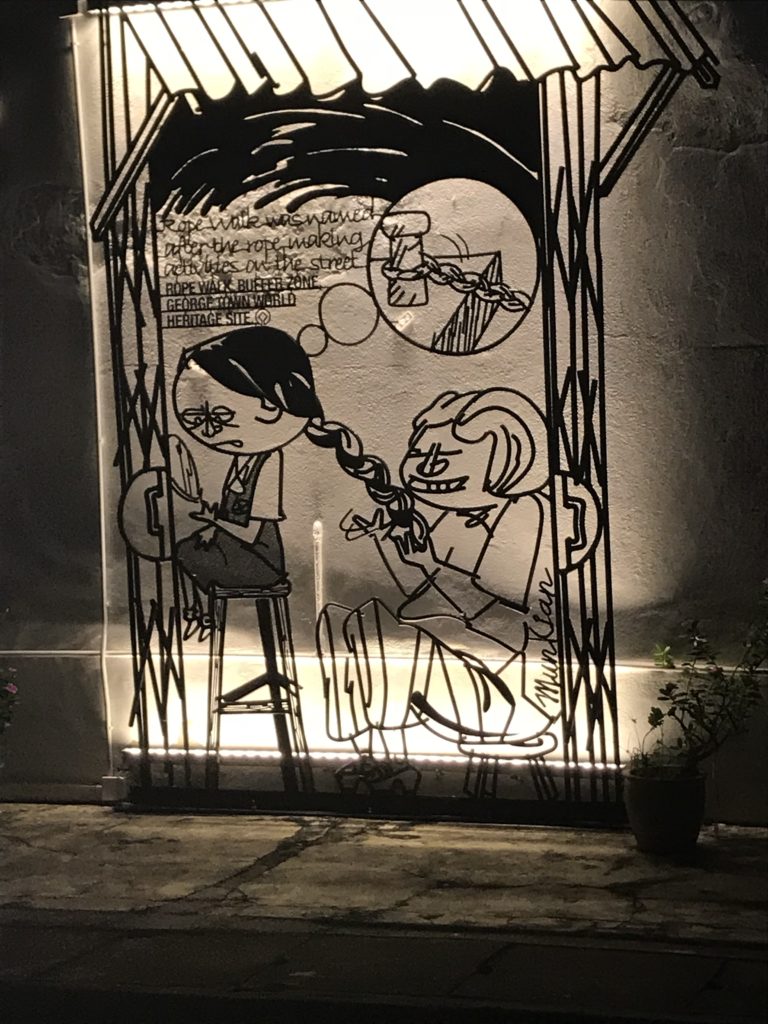
We are staying at a place called “Rope Walk Guesthouse” – initially I’d thought perhaps there was some gimmicky rope bridge within the facility, but apparently this was a part of the city that once was home to places that made rope. So, there you go.

I am a little bit giddy at the amount of options of things to do here. Our guesthouse provided us with a map that not only helps orient us to the city, but also lays out it’s rich public art scene. Apparently, when they designated this area (Georgetown) a UNESCO site, the city was challenged with how to tell the story of the history of this place. It was decided to do it through art and they commissioned a number of cartoonists to create metal sculptures on different walls around the city telling the story (often in a humorous way) of different neighborhoods and streets (this is how I found out about “Rope Walk”). They also have a bunch of larger than life murals that I hope to visit too.

Photo Jan 25, 9 19 13 PM

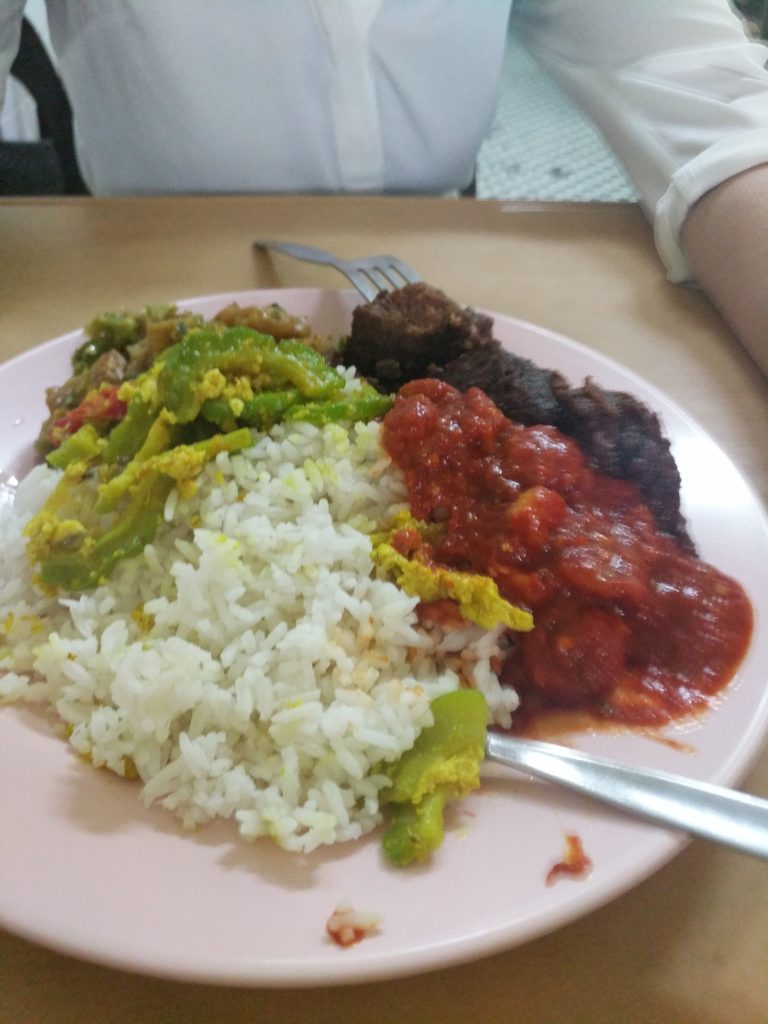
After orienting ourselves a bit on the map, we set off to explore the street art and grab some lunch. Ray’d found a place he wanted to try online, but being unable to locate it, we stopped instead at a storefront where a bunch of locals were seated. They had a plethora of green, red, and brown vats of meats and sauces out front and a menu (not in English) on the wall. Ray asked them to direct us and they graciously did so, telling us they’d give us a plate of rice and we could load it up with scoops of the different curries and meats. The only one we were clued into was an delicious spiced beef called Rendang that, according to the restaurateur, is famous in Pedang, Indonesia. We also had three other fabulous items, but I’m not sure what they were! All for a whopping $6 for both of us.

2018-01-23 16.38.19

While I’d wanted to explore the street art some more, I was simply overheated, so we retreated to our air conditioned room (it seems in Penang, folks mix AC and open windows much more than at home – our room doesn’t have glass in the window, just shutters). During our break, it started to rain and I couldn’t resist taking a nap. I woke up to a heavy downpour which soon cleared up.

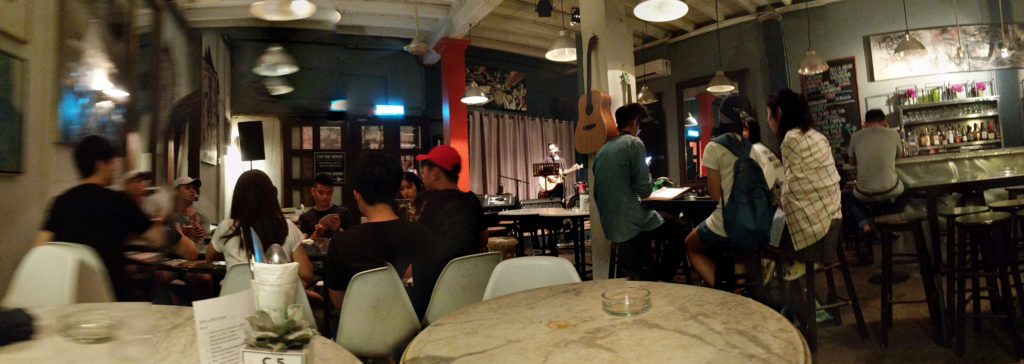
By this time it was dark, so we decided to go get some dinner and entertainment (Ray did a bunch of research while I napped). We went to a place called The Canteen which has nightly live music and cheap(ish) food. Drinking is generally looked down on in Malaysia, so the drinks cost more than the food. The musician this evening was a talented young local guy (I assume) who played acoustic covers. He accepted requests and we were surprised to find he didn’t know any of the eight or so options we suggested, his wheelhouse seeming to reside in 2000’s pop. Regardless, we enjoyed our sweet potato fries and beers in the company of Australians, locals, and others.

2018-01-23 21.11.05

I’m looking forward to tomorrow as we are spoiled for choice here, even if the weather doesn’t shape up!

2018-01-23 20.19.14

Thailand | Day 2 – Walking Tour

2018 Southeast Asia

One major difference we’ve noticed between this trip and our last big (Europe) trip is the complete lack of walking tours. Last time, that was our first agenda item in each city and served as a way to get oriented. Today (with the help of the GPSmyCity app) we took ourselves on a walking tour of Chiang Mai.

After a sweet breakfast (actual eggs-and-sausage-and-coffee breakfast, not noodles!) at the restaurant in our hostel, we took off on foot. Our tour got off to a rocky start at our first stop, Tha Pae Gate (one of the main gates to the “old city” of Chiang Mai), when one of the hundreds of resident pigeons let loose right on top of our heads. Grossed out but undeterred, we continued on into the old city, stopping at a number of monuments and opulent Wats (Buddhist temples).

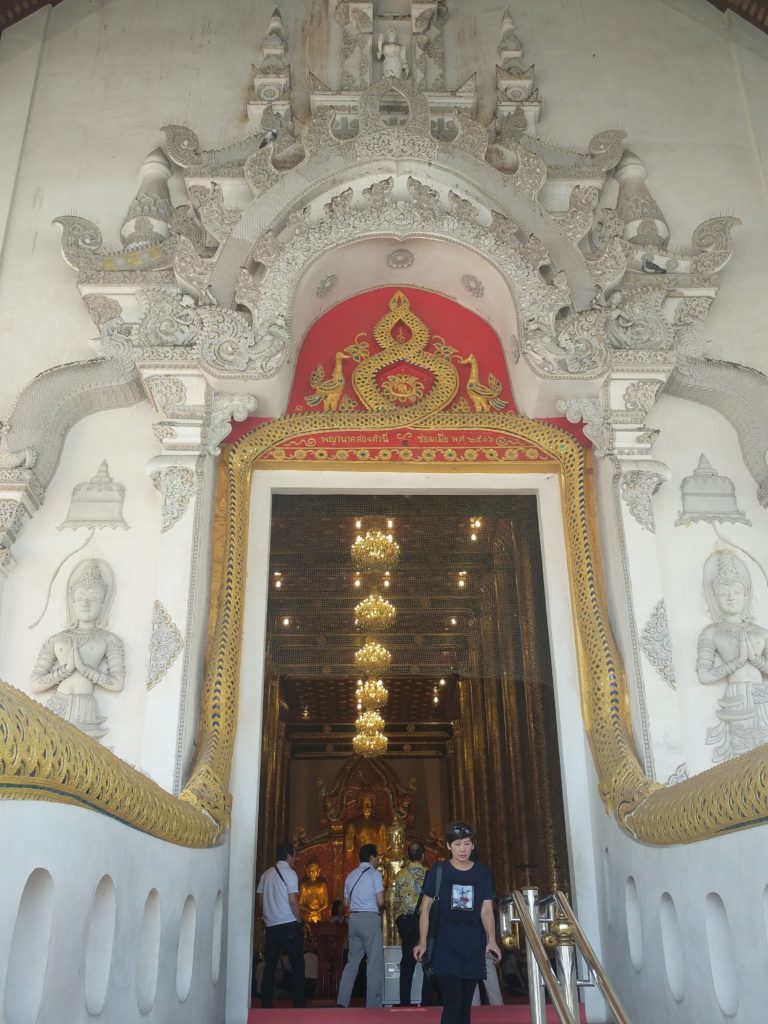
Entrance to one of the many ornate temples we visited. Note the soaring ceilings and chandeliers!

Entrance to one of the many ornate temples we visited. Note the soaring ceilings and chandeliers!

Because we needed to do laundry today, we were limited in our clothing options. While my outfit was determined to be okay for visiting temples (knees and shoulders covered), Ray’s shorts did not fit the bill and he often had to borrow one of the complimentary sarongs to tie around his waist. On the other hand, my outfit did not have pockets (go figure), so Ray was the only one who could navigate, handle financial transactions, and take photos for the day.

This was not the only patriarchal annoyance of the day: on the grounds of Wat Chedi Luang (built in 1475), the “city pillar” (dedicated to the spirit of the city of Chiang Mai) is housed in a building that only men can enter because women menstruate and that would “defile” the spirit of the city … yeah, okay.

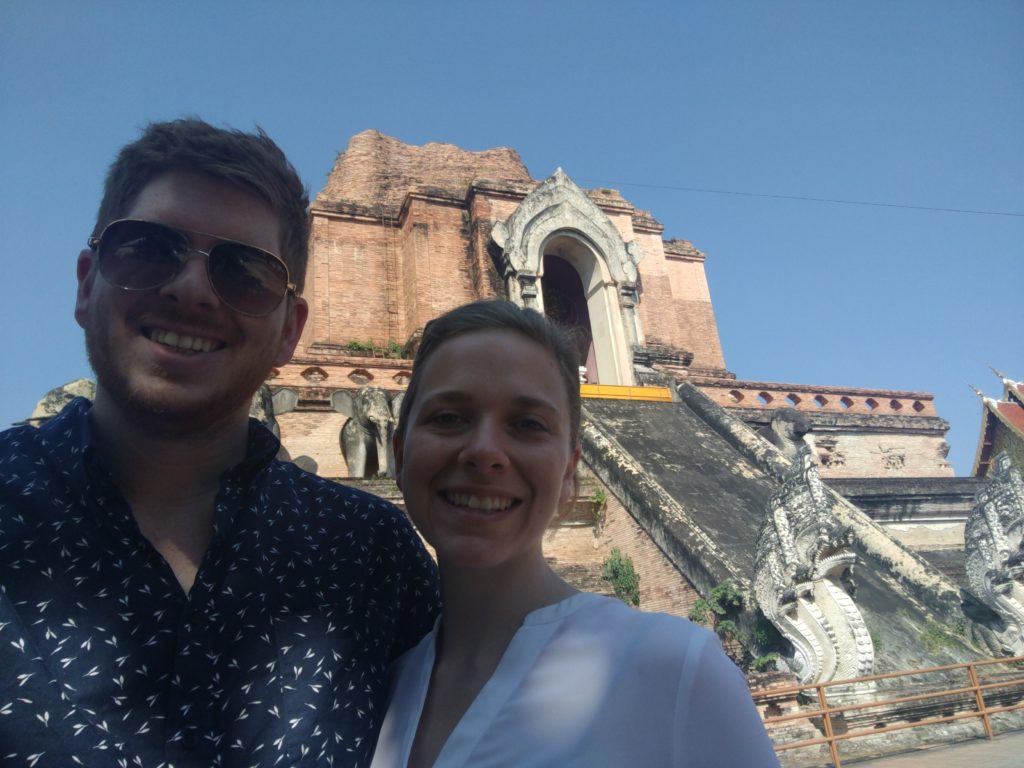
All that aside, Wat Chedi Luang was really quite neat. It is a massive pyramid-like structure with four sides guarded by giant elephants and staircases (now defunct to deter visitors from climbing) framed by giant naga snakes. It was destroyed by rains and an earthquake in 1575.

2018-01-21 13.51.21

Neither of us being very familiar with Buddhism, we had some questions and, fortunately, got the chance to talk to two very young monks through a program called Monk Talk where those who are studying English get a chance to practice (we were amused to find these two monks on their smartphones as we approached). Turns out the Buddha on the Naga Snake (referenced in our post on Angkor Wat) stems from a pre-enlightenment story in which the snake protected Buddha and also is good luck for those born on Saturdays. Also, the form of Buddhism practiced by the Dalai Lama is a different form than is practiced here (the same way Lutheran / Christian Reformed / Catholic are different forms of Christianity).

We also saw the “Three Kings Monument” which honored the three Northern Lao Kings who founded the city of Chiang Mai. I found this especially interesting given that earlier in the day we’d learned that the Thai defeated the Lao in some battle. When they went from being friend to foe, I don’t know.

Very thirsty after our long walk (it was estimated to take two hours and we ended up taking at least five!), we stopped in a cafe to sip on yummy banana and papaya shakes while watching the Sunday Night Market take shape on the street in front of us. We spent the remainder of our evening walking through the night market (which was much more manageable than the one last night) and finding a couple of treasures before jumping off of the walking street just as the crowds were getting heavy for a delicious dinner of curry and some cold beers.

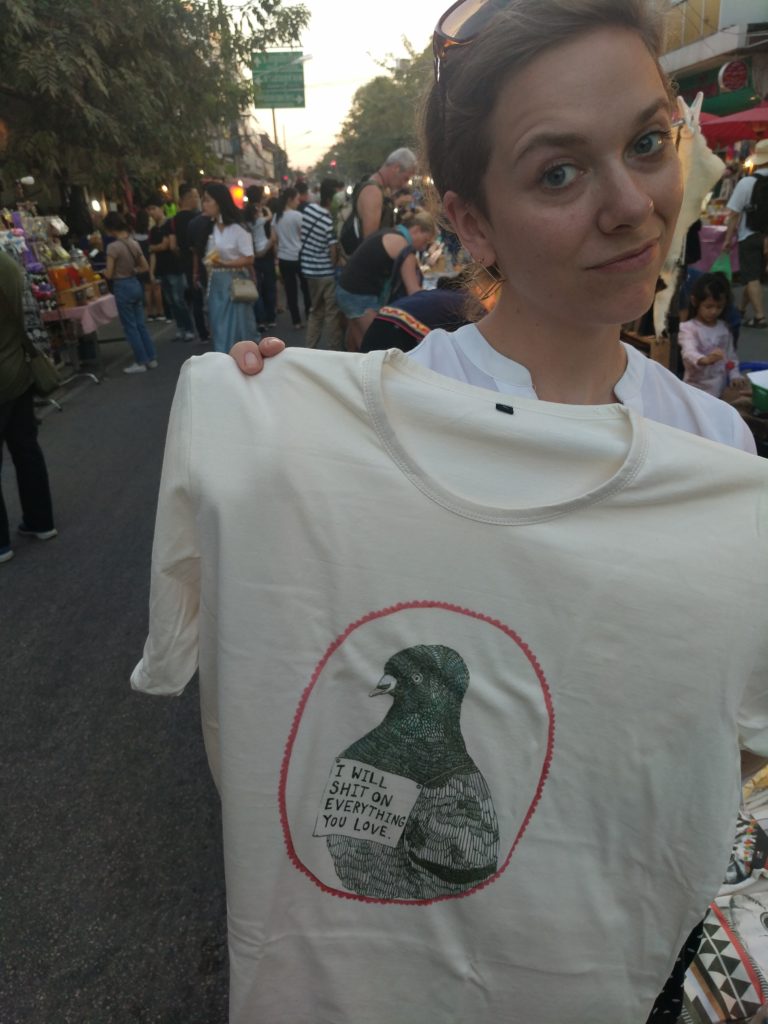
At the night market. For some reason, this shirt speaks to me ...

At the night market. For some reason, this shirt speaks to me …

Walking back to our hotel along the gorgeous moat / canals, we reflected on our privilege at being able to take this trip, the challenging dichotomy of wanting “authentic” experiences while not disturbing the local culture, our excitement for the last days of our journey, and our longing for home.

Travel Day: Islands to Thailand

2018 Southeast Asia

Not a whole lot to report today as it was mostly traveling. We started our journey with a speedboat ride from Cat Ba to Haiphong. We had a lovely seat up front surrounded by windows. Fun as it was, it probably would have been a good day to take a Dramamine – it was awfully bumpy! But we survived with our breakfast in its rightful place.

0003BBB2-820B-43BB-AB1C-5AF4FA9DBAE7

Next we were bombarded with folks trying to get us to take their taxis. Ray showed some stellar haggling skills, recalling what we’d paid for a taxi to get here last time and talking the person down to there. I thoroughly enjoyed the cultural mashup that was our ride to the airport: our Vietnamese driver with Buddhas and a Vishnu on his dashboard listening to Despacito.

The theme of today was arriving earlier than needed, I suppose. We got to the airport and had to wait for our carrier’s desk to open, then we had to wait even more for passport control to open. Thankfully there were no issues either place, so we were soon on our way to Chiang Mai, Thailand via Bangkok.

Bangkok’s airport is HUGE and BUSY. We made our way through immigration and customs with plenty of time to spare before our next carrier’s counter was open. Once it did open, they weighed our carry on bags for the first time and found they were too heavy so we re-consolidated our things and checked one bag. We were pleased to find the airport had a great selection of food and had some really yummy ramen before getting on our flight.

1FBC5841-A83A-4941-9D65-75EC85E38904

We got to watch the sun set from the air and see the lights of Chiang Mai as we landed. We grabbed a luxurious taxi and drove through the city which seemed so … clean! We were accidentally dropped at the wrong hotel, but thankfully it was just a short walk to the right one. Ray ran to an ATM while I stayed with our bags and returned with not only the cash for the hotel, but also a giant bottle of water and a Snickers bar. My hero!
Vietnam | Day 4 – Island Living

2018 Southeast Asia

We were woke this morning by roosters crowing. Arriving in the dark last night, we were unaware of our surroundings, so finding a brood of chickens and roosters outside our window was an entertaining surprise.

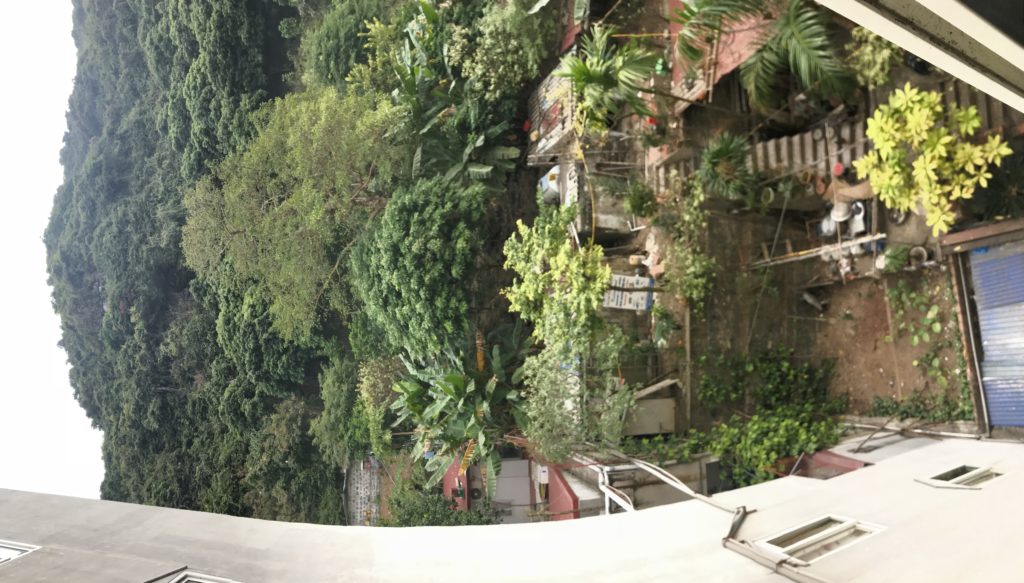
Mountain to chickens: the view from our window

Mountain to chickens: the view from our window

We had not really planned much of anything for our stay here. My only two must-do items were to 1) go to a beach and 2) go kayaking. On our way to our [massively underwhelming] free hotel breakfast, we saw that a tour company associated with our hotel had a very affordable tour tomorrow (my birthday!) that included kayaking and snorkeling, so we signed up for that and then went exploring.

We thought it might be neat to do a little exploring on kayak on our own today, but were told the more direct way to the rental place was under construction, so we took the longer way around which brought us out of the more tourist-y area of the island and onto streets where the line between home and business were blurred. Storefronts with signs advertising food were obscured by children playing, women washing clothes, people cutting or drying fish. It was actually quite lovely as the area were are primarily in is definitely not the “real” Vietnam. This felt closer.

A couple turns in the road later and we arrived at the pier where we were immediately approached by many people offering us rides on their boats. We saw the kayaks, but decided instead to spend the day at a beach, knowing we would be kayaking tomorrow.

05395347-6647-4B77-B3B9-89CD15812087

On our way back, we climbed a set of stairs set in the lush cliff-side. While beautiful, we realized it was a cemetery of sorts. Already slightly afraid of breaking any local social taboos, we made our way back down.

2018-01-17 11.08.30

We had every intention to go to “Beach 2” which I’d read was the most beautiful, but apparently it (or at least the road to it) was under construction and unreachable. We are, after all, on an island (one in which there are likely unexploded land mines in the less-trod areas) so finding an alternate route was out of the question. It was a bit disappointing to see the remarkable amount of development on the island. It seems they are putting up more and more hotels and other tourist-focused things at the expense of easily accessible, beautiful public spaces.

We made our way down a set of stairs to “Beach 1,” but noticing it was rather dirty and with no access to amenities, we decided to see where the man-made trail took us. Taking in breathtaking views the whole way, we finally arrived at “Beach 3” which was on the property of a resort. We rented some beach chairs and got a couple of cold beverages and settled in with our books and the sunshine. It was really lovely. Until the clouds overtook the sun and it became too chilly to stay much longer.

IMG_0663 IMG_0670


3532AA80-A525-405D-9971-7982959AECAE

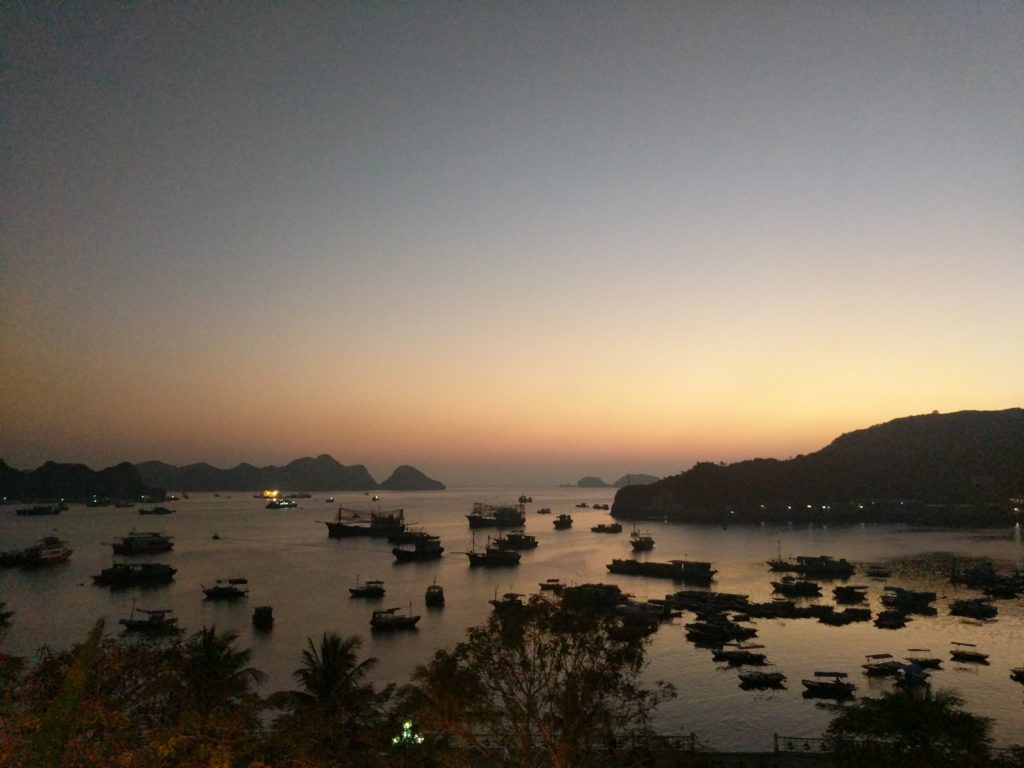
Back in town, we went to get dinner at a restaurant that Trip Advisor had rated highly, but they weren’t open yet. We took a leisurely stroll around the river, got a yummy bahn mi sandwich at a street cart, astounded at our luck in being here when there are relatively few people, and beautiful but not hot weather. We noticed a hotel with a rooftop restaurant at the top and decided to get a drink there as the sun set.

2018-01-17 17.55.35

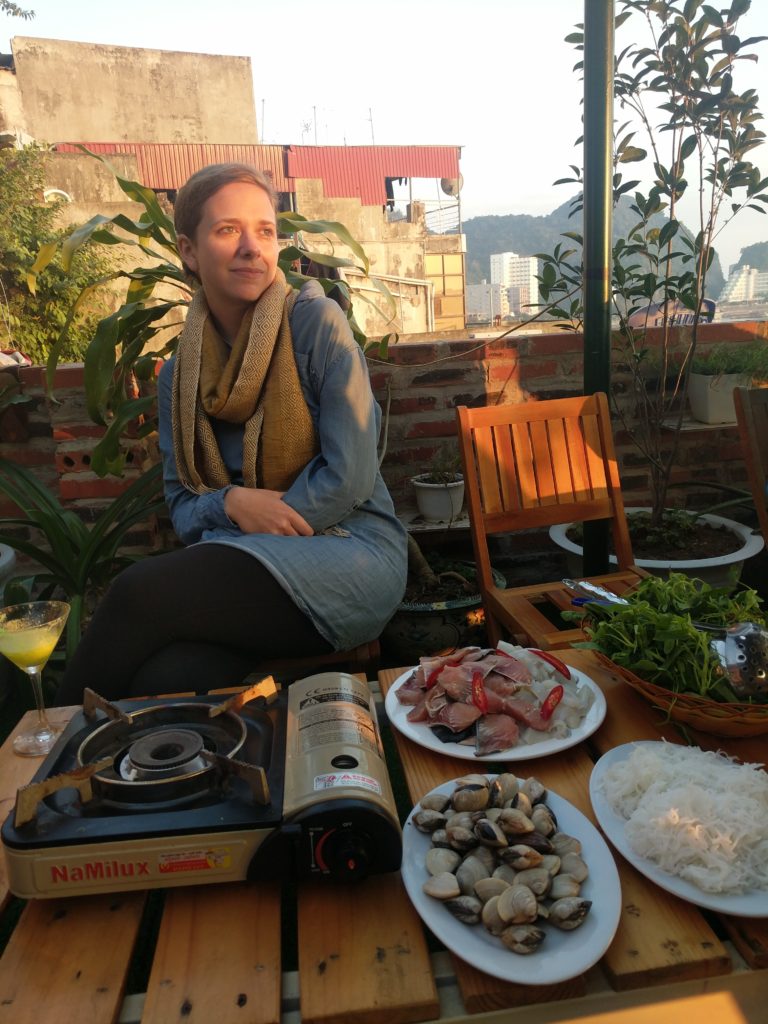
Mona’s was definitely built with Westerners in mind – everyone on the roof was white and they were playing a mix of slow French lounge jazz and Johnny Cash. We ordered our drinks, but then decided to get dinner too. We ordered a “Hot Pot” which we’d seen around. It was delivered to our table in three trips: a pile (literally a pile) of fish and squid, a plate of clams, a stack of greens, a plate of noodles, a tabletop gas stove, and a giant pot of broth and vegetables. Our server sat with us and explained how to do it – putting each item in the boiling broth for a certain amount of time and then ladling the meat, noodles, and veggies into smaller bowls to eat like a soup. On the menu, it said it fed two people. There was easily enough food for four. Multiple times different servers came over and asked if we needed help. I’m not sure if that was because we were doing something wrong, but it tasted good enough!

2018-01-17 17.07.23

As we finished our meal, we struck up a conversation with an older woman sitting by herself from northern England. We’ve noticed a number of older folks on this trip traveling solo and I’ve been very curious to hear their stories. While I’d thought perhaps it would be a story of losing a partner who disliked travel or reconnecting with roots or something, hers was a simple “I’ve got time off and wanted to explore.” Same as us!

Bellies beyond full, we made our way back to the hotel with plans to get up early tomorrow (perhaps with the first rooster cry) to watch the sunrise.

Vietnam | Day 2 – Adventures in Tailoring

2018 Southeast Asia

After breakfast in our hotel lobby (a mix of breakfast favorites to suit worldwide palates – cereal, tomatoes, noodles), we made our way to attempt to meet a guide to show us around town. Because I’d made the reservation so late (midnight), I wasn’t confident our guide would be there, and I was right. So we went with Plan B, which was to just meander around the Old Town. I was very relieved to find the crowds much smaller today than yesterday!

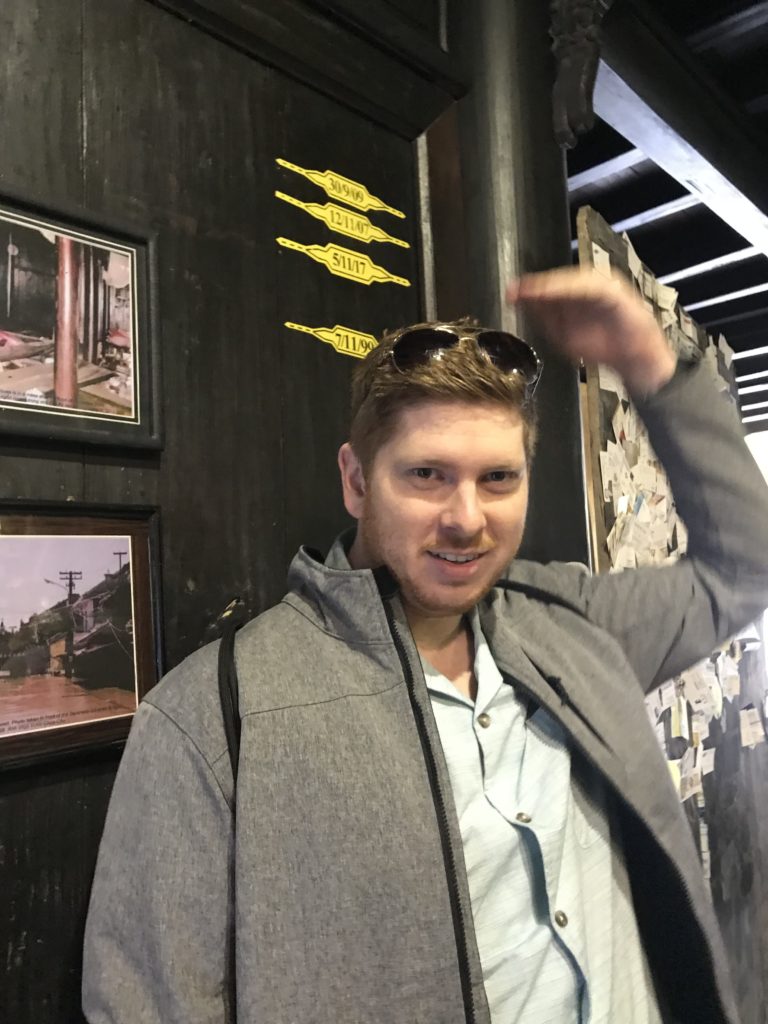
At Tan Ky house, learning that Ray’s zodiac is “Dragon” (strong) and mine is “Rabbit” (small and cute) ... eh, close enough

At Tan Ky house, learning that Ray’s zodiac is “Dragon” (strong) and mine is “Rabbit” (small and cute) … eh, close enough

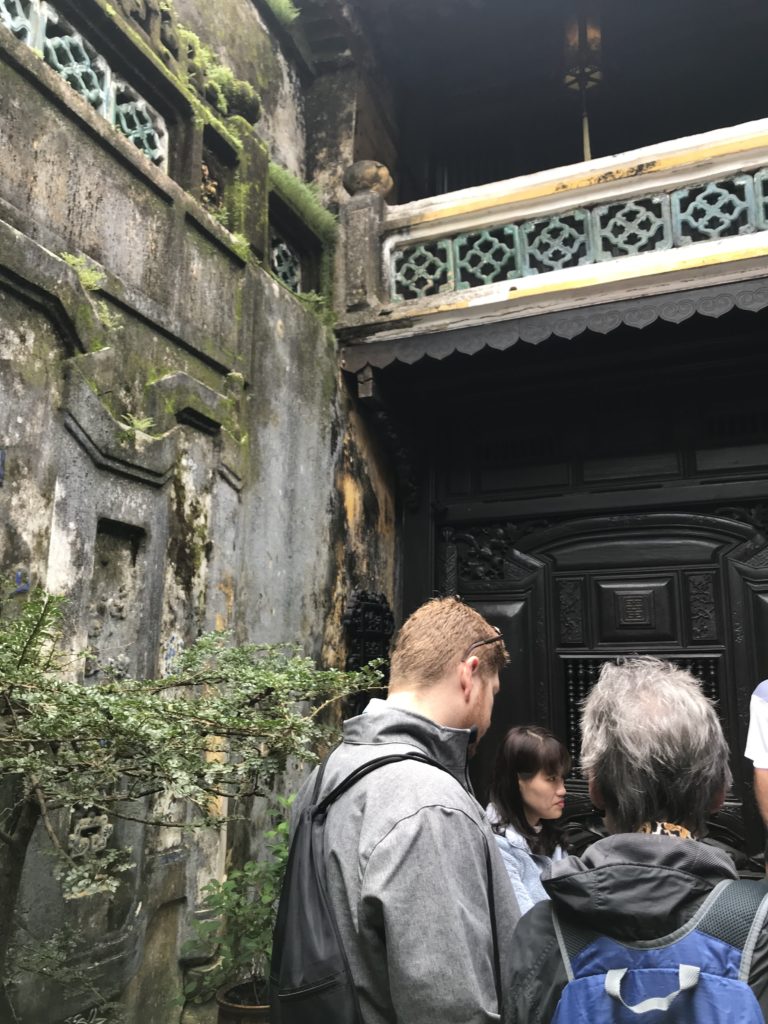
When you go into Old Town, they sell you a ticket which gets you in to multiple historic sites. We meandered through the winding, lantern-strung streets, through mossy alleyways, and among aged yellow shops before we found our first stop: Tan Ky Ancient House. This was the home and shop of a merchant in the 18th century; the 5th generation still lives upstairs. As a merchant’s home, it is built with it’s back-end facing the river and the front end facing the street where folks could buy their wares. In the kitchen area they have markers of how high the flood waters have gotten over the years (yes, it floods in the house, but they have developed a system wherein the inner walls can be raised by pulley to keep them dry).

Ray’s head would have been underwater last year

Ray’s head would have been underwater last year

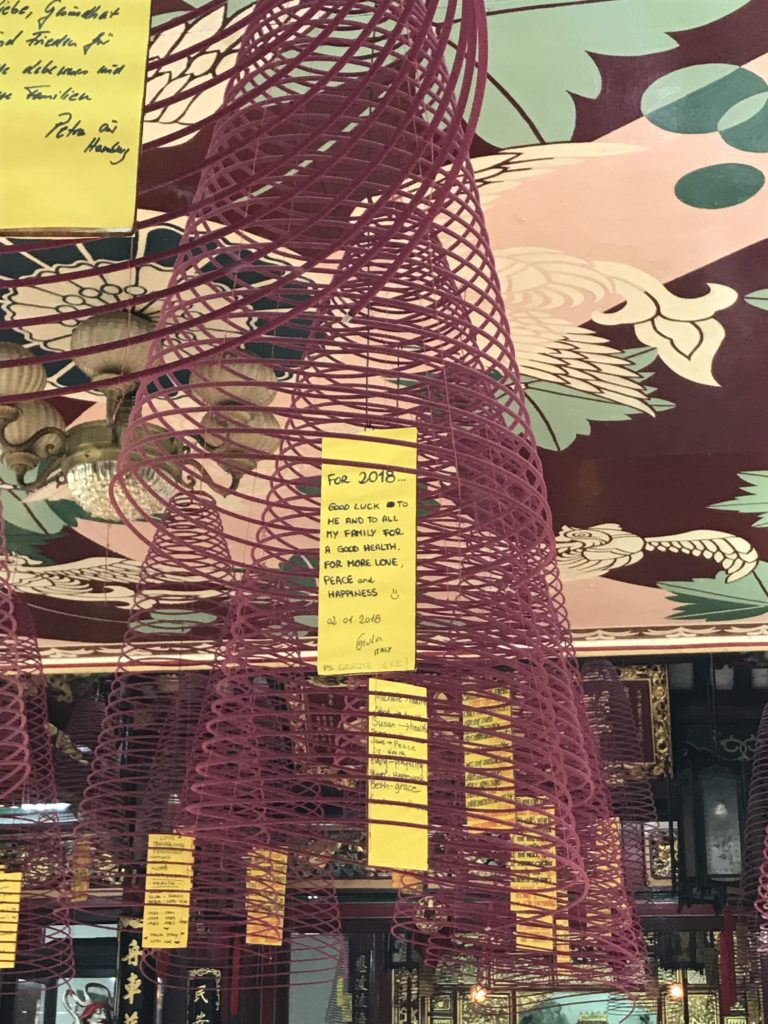
From there, we stopped at the Fukian Assembly Hall. The assembly halls were cultural hubs for the many Chinese and Japanese immigrants who made their home here. This one in particular was for the Chinese immigrants who came from the Fukian province and served as a temple, meeting place, and more in the multicultural city of Hoi An. Hanging in the middle of the hall were what at first glance appeared to be a bunch of Christmas trees but are, in actuality, incense. The idea is that people can write down their wish or prayer and the incense will burn for a month.

DA0D16AF-9CA5-4A50-BE08-31EADA862A5B

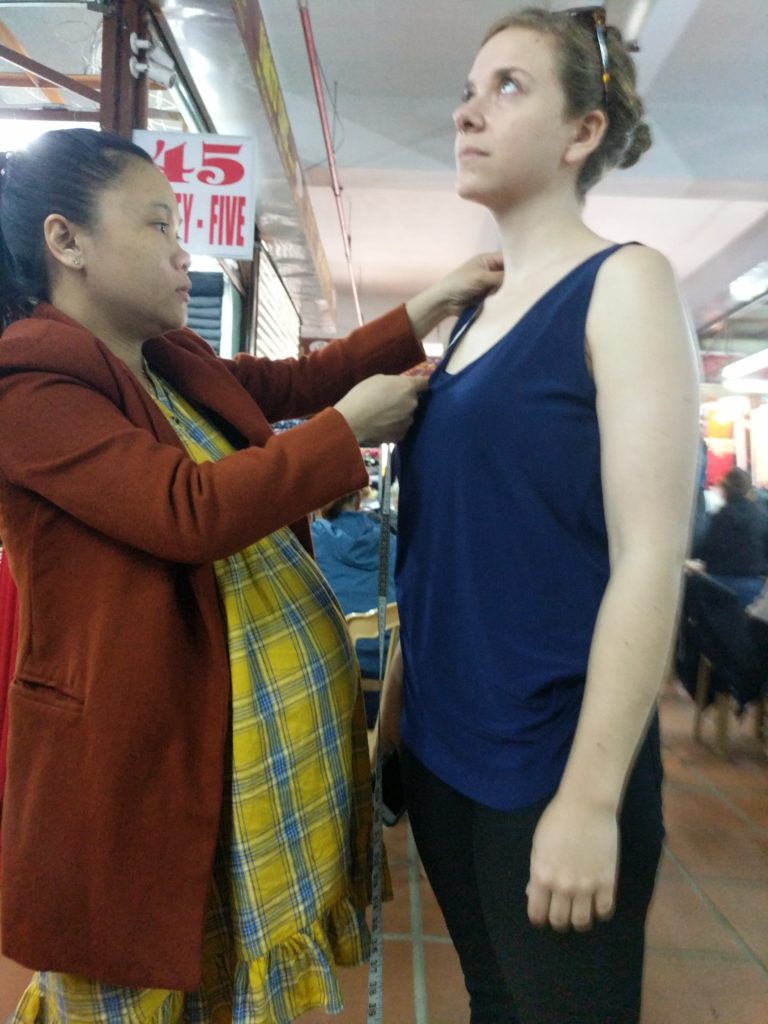
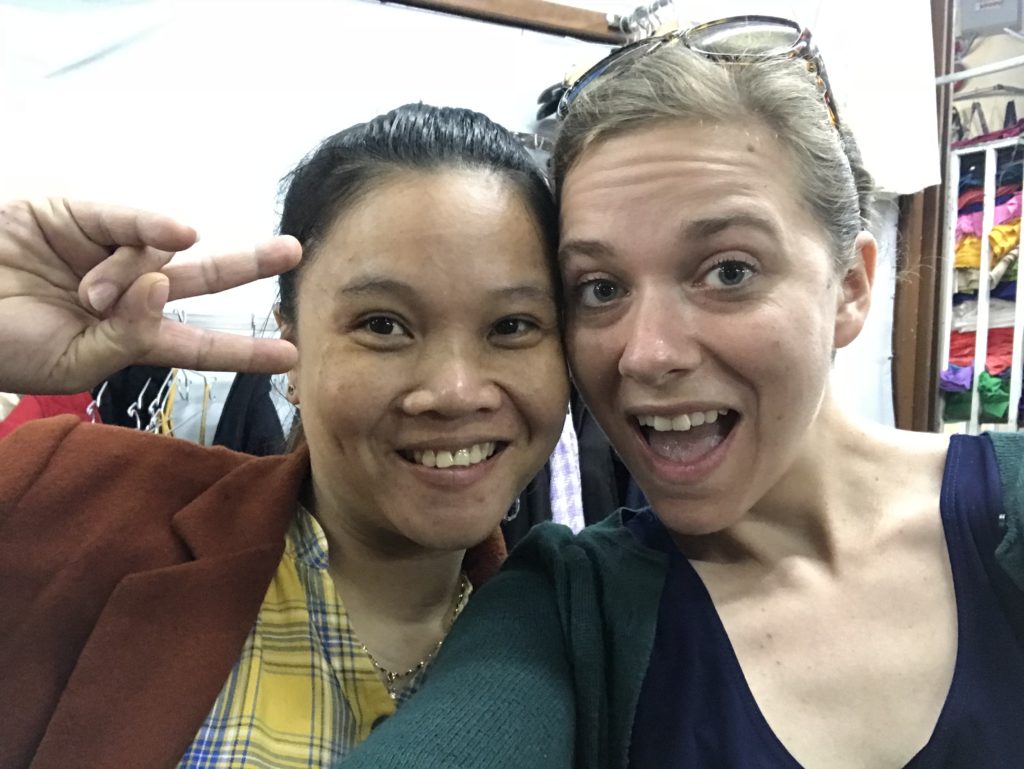
We continued to meander around town, stopping in at a performance of traditional music and craft shops. We were on our way to a museum in town when a woman talked us into coming to see her tailoring shop, run by her and a dozen or so family members. Now, Hoi An is known worldwide for its tailoring. While we weren’t expecting to get anything, neither of us could pass up this unique opportunity to have something (or things) specially made for us at a steep discount from what you’d pay in the states. We looked through catalogues of different styles of dresses, coats, and pants, chose pieces we liked, and then were able to chose the fabrics as well. They told us to come back in six hours for a fitting.

My VERY pregnant tailor sizing me up.

My VERY pregnant tailor sizing me up.

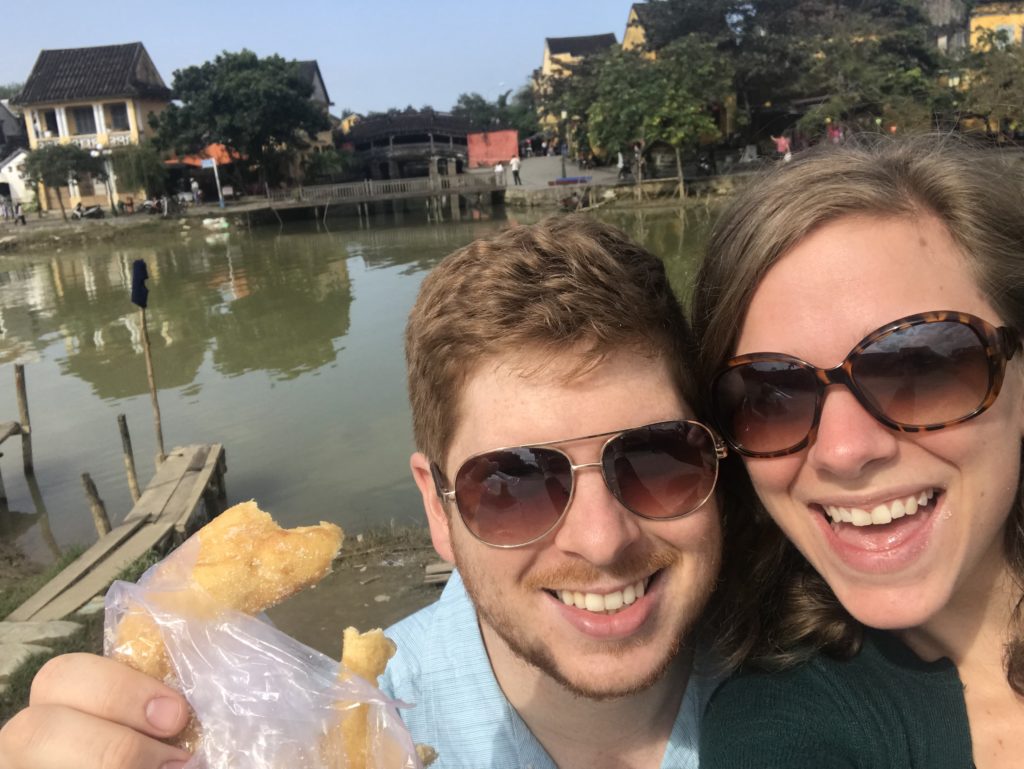
So, we continued meandering around the Old Town (they’ve got a pretty smooth operation here – bring ’em in for tailoring and occupy ’em with pretty streets and lots of shopping while they wait). We tried a Vietnamese Doughnut, visited the Japanese covered bridge (actually built by Chinese and Vietnamese folks), and had another Bahn Mi before stopping for a drink by the river.

Doughnut with the Japanese Covered Bridge across the river

Doughnut with the Japanese Covered Bridge across the river

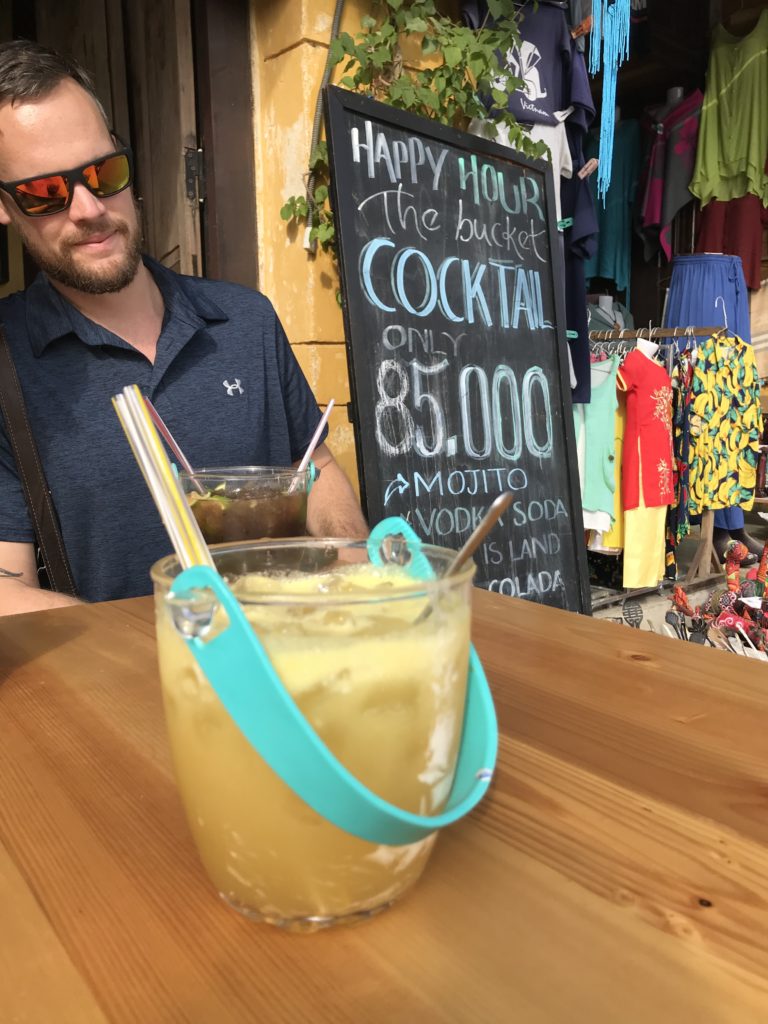
We happened to arrive at the same time as a couple from New Zealand and the server mistakenly sat us together but we were all okay with that and proceeded to chat with them for a good long while. They, too, are both getting married soon and she is between jobs like me. Unlike us, however, they have spent the last 6 months traveling around the world! A couple of “buckets” of alcohol later, we were all on our way for fittings.

Our New Zealand friend Jai and a bucket of Pina Colada

Our New Zealand friend Jai and a bucket of Pina Colada

With my tailor

With my tailor


E4F8CC33-2EB3-4666-90E1-C4448DBCCFC2

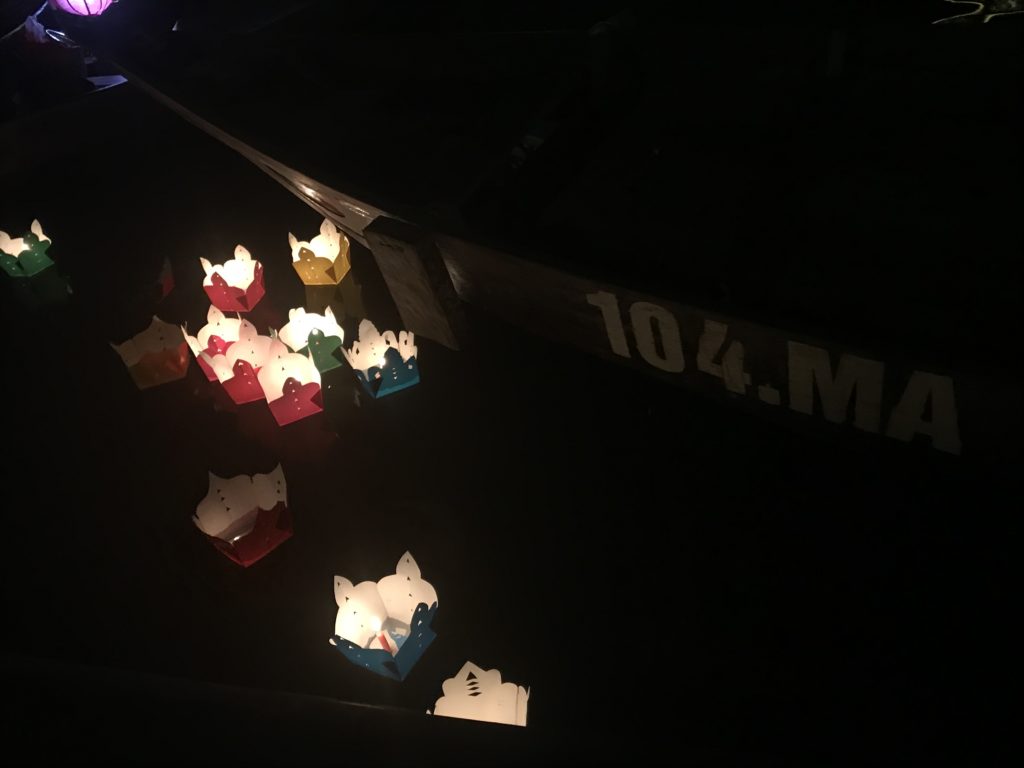
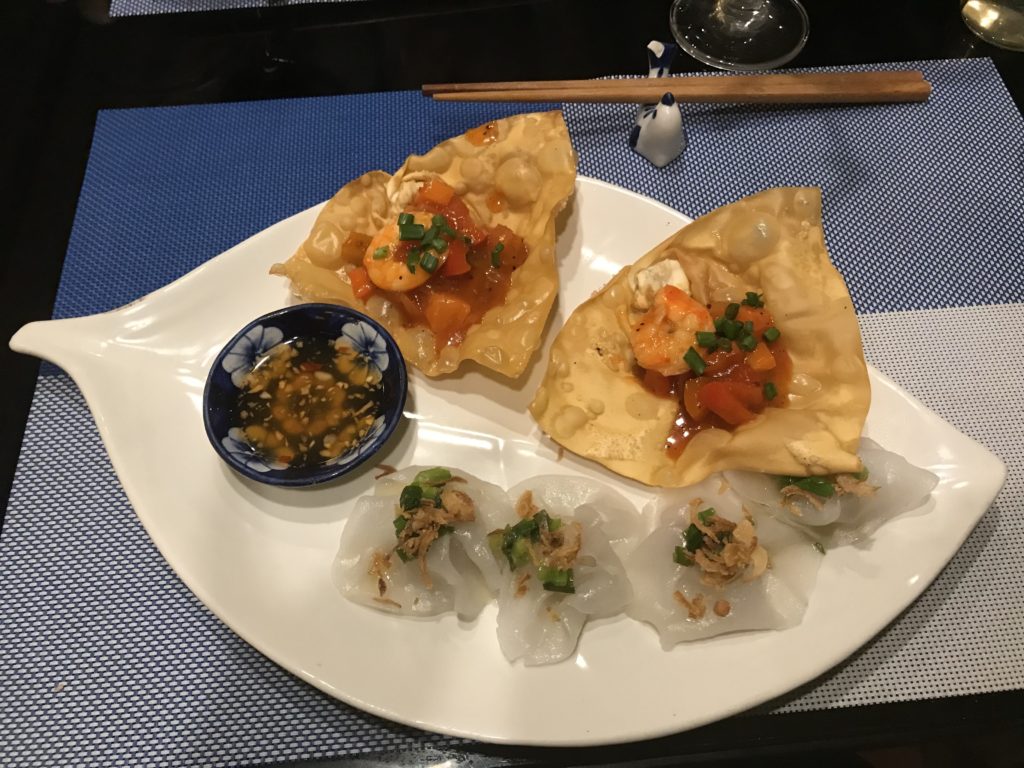
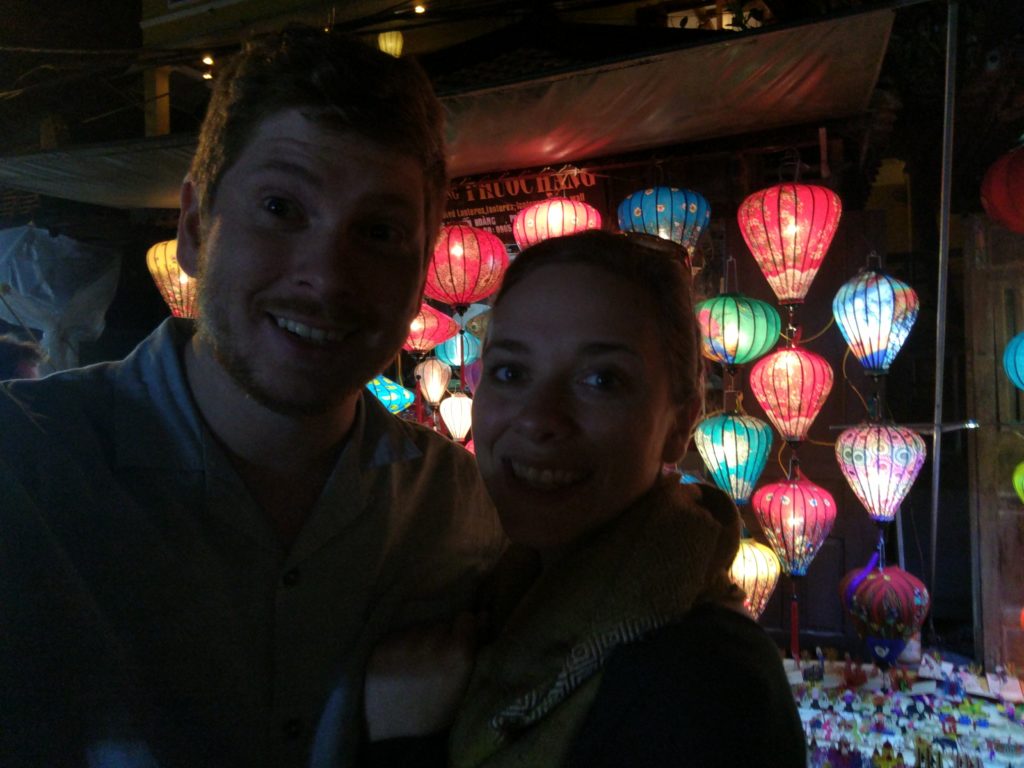
After our fitting, we sat by the river for a while, enjoying the juxtaposition of bustling crowds and beautiful lanterns in the sky and on the water, before making our way to dinner. We’d been wanting to try some of the local specialties – White Rose and Cau Lau (a dish only made in Hoi An, with noodles from a secret recipe) – and found a place in an alley that was uniquely empty and had both of those items on a tasting menu. In addition to White Rose and Cau Lau, we were also treated to a crispy wanton with a spicy seafood chutney and a dessert of coconut tapioca pudding with banana.

The White Rose dumplings are very challenging to make. They are made by one family in town and distributed to all of the restaurants

The White Rose dumplings are very challenging to make. They are made by one family in town and distributed to all of the restaurants

Now we are back at our hotel trying to tie up any lose ends before a busy morning picking up our tailored items and catching a taxi to the airport.

2018-01-15 20.12.44-2

Cambodia | Day 4 – Monks & Monkeys

2018 Southeast Asia

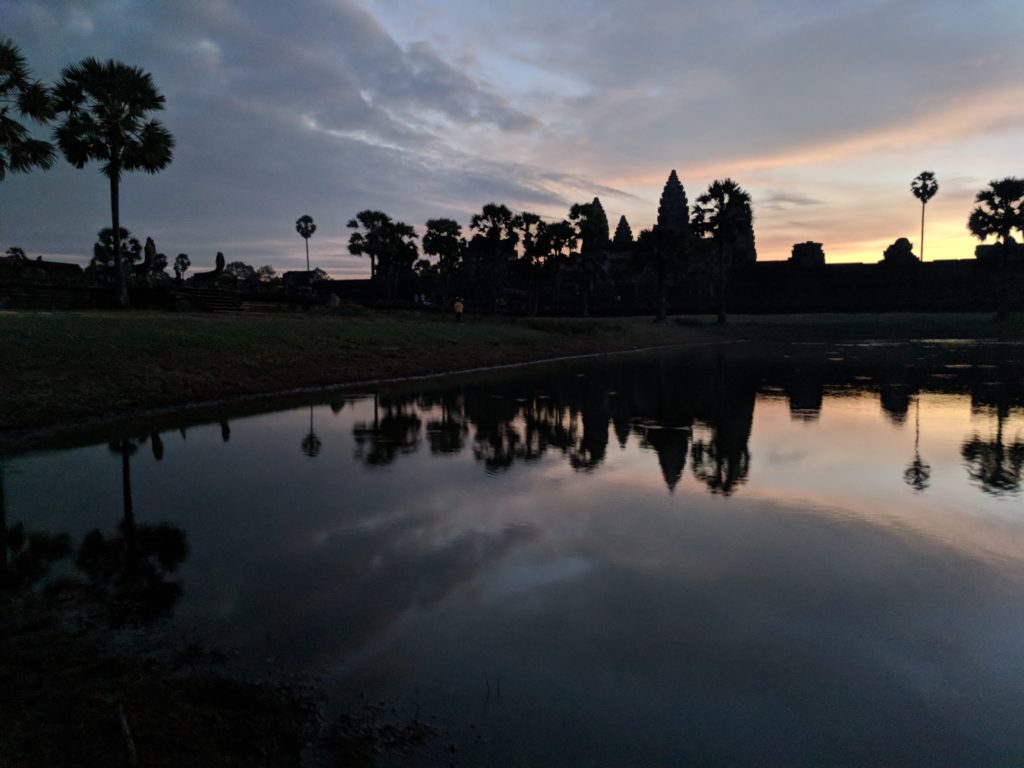
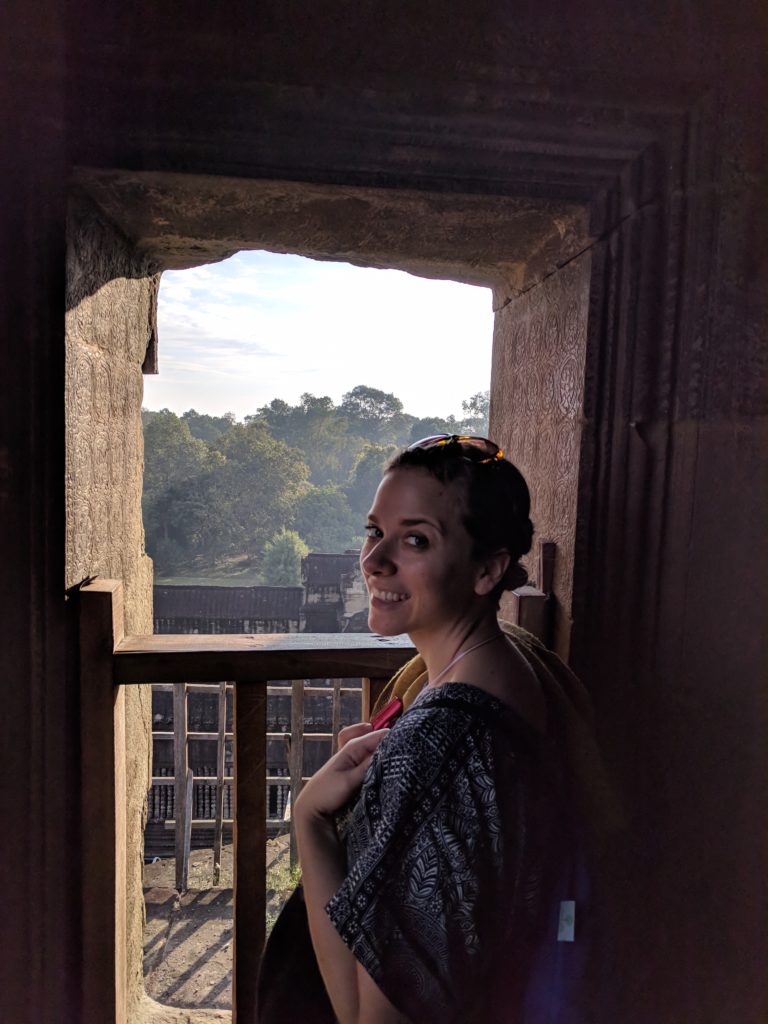
Woke this morning while it was still dark to catch the sunrise at Angkor Wat. Wrapped in my lovely new silk scarf to ward off the chilly morning air, we met our Tuk Tuk driver Blake and were whisked off under the cloak of darkness to the ticket station on the outskirts of this UNESCO world heritage site. After waiting in a relatively short line and grabbing some coffee and rolls (running into one of our fellow boat passengers from yesterday), we again blindly were driven to a dark parking lot. Blake instructed us where to go and where we could meet him when we were done. We followed a sea of bouncing flashlights over a dirt path, along a bouncy buoyant bridge, through an ancient archway housing a giant Vishnu cloaked in gold, and onto a dark pathway. Ray led us to the right. We stopped just short of some water and sat down, waiting for the sun to rise.

IMG-3595


As the sky became brighter it was as if the world became clearer, crisper. As if the sun were coloring in each object one by one. It was really beautiful to feel the collective anticipation of the people around us as the horizon buzzed orange and pink.

2018-01-13 06.08.47

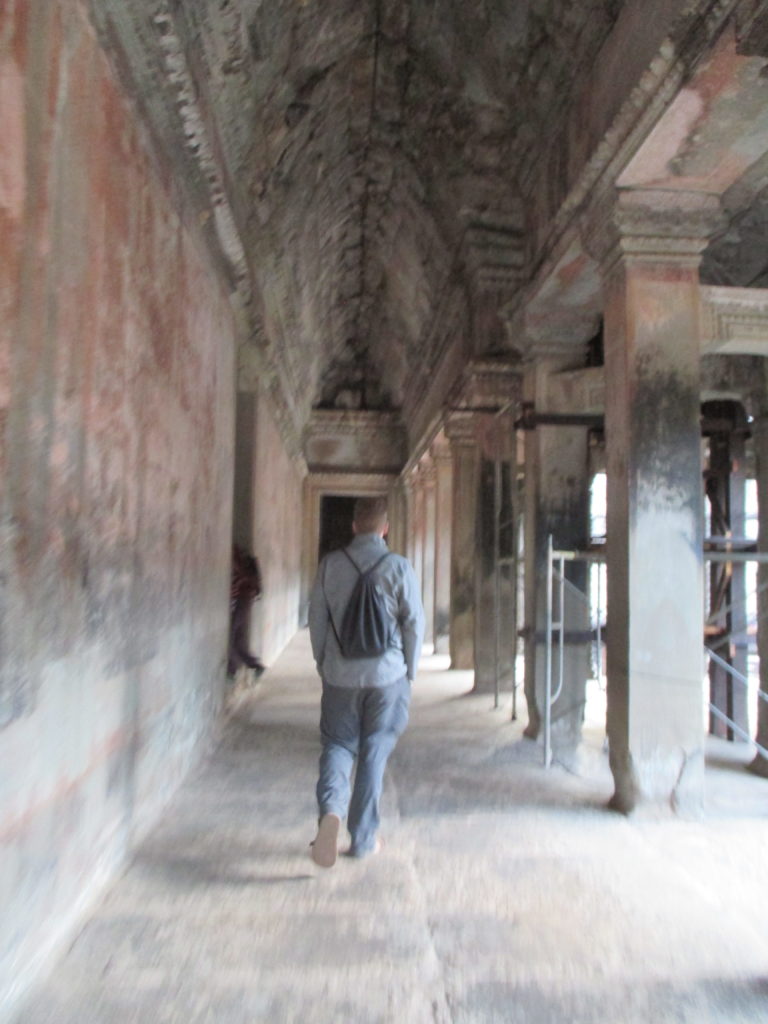
Once the sky was bright enough, we headed into Angkor Wat, hiring a local guide to give us some insights on what we were looking at. Much of what was explained reflected what we’d learned at the National Museum in Phnom Penh: the country was Hindu until one of the kings converted to Buddhism, then the country became Buddhist and all of the Hindu statues in the temples were replaced with Buddhas – though Hinduism was still tolerated and accepted, so the Hindu gods were just placed outside of the main temple (hence the Vishnu we saw on the way in wearing traditional Buddhist robes/colors) and some of the intricate carvings were painted red. One of my favorite mash-ups are the many many statues of Buddha sitting on the 8-headed snake Naga from Hindu mythology.

IMG_0545

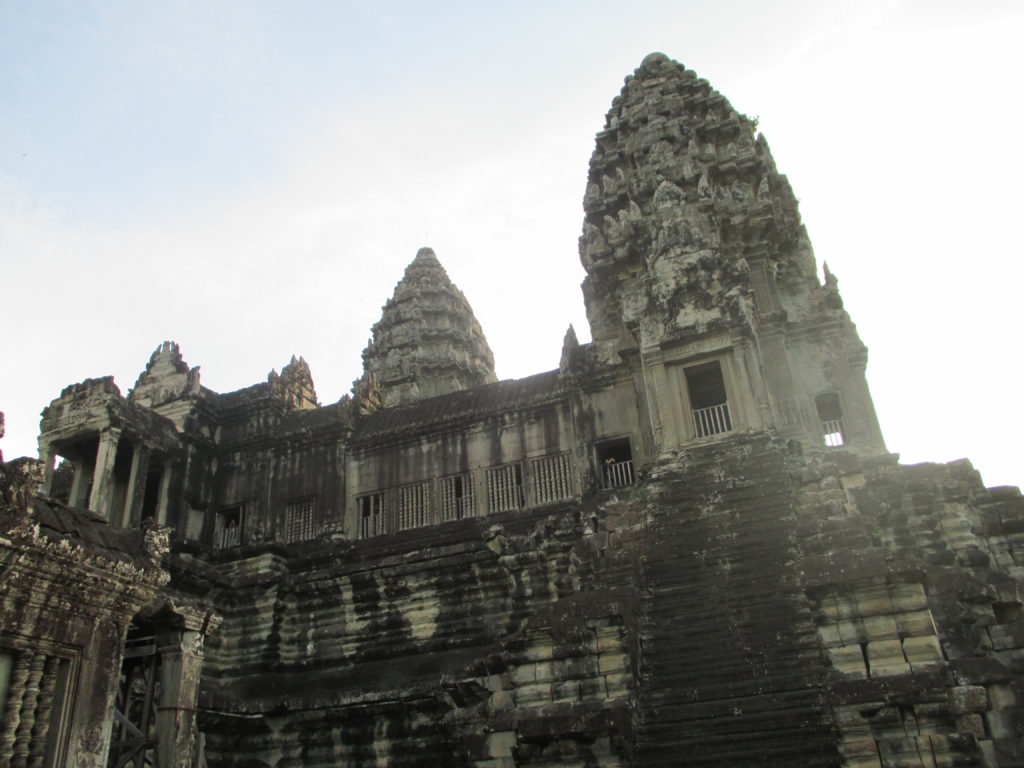
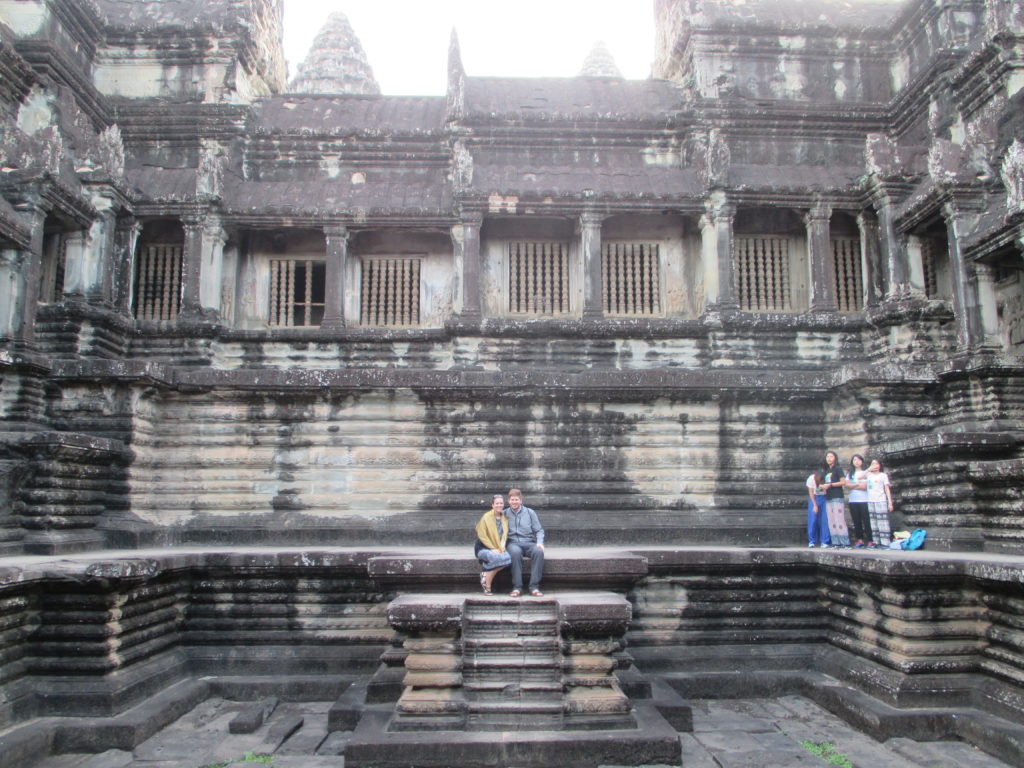
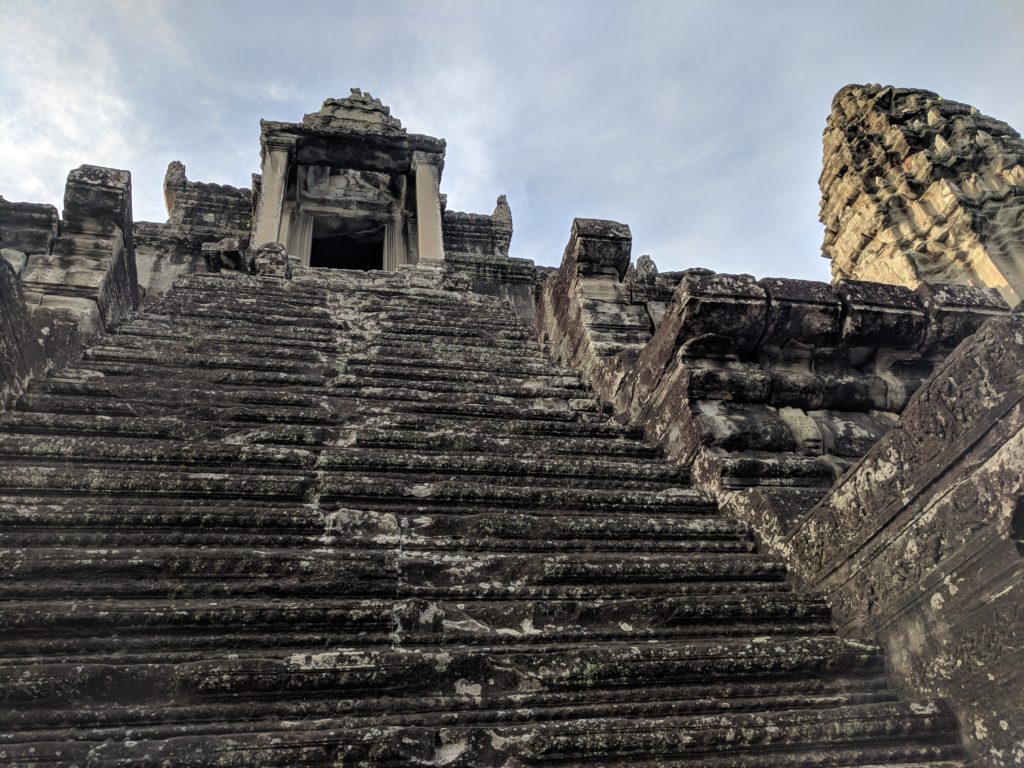
This temple was built in three layers – the first section is about history and contains visual accounts of historic and/or mythic events. This section is also available to the “common people.” The second story is dedicated to meditation, with it’s long hallways and echo chambers wherein you can hear a thump on your chest echo back. This section was reserved for the kings’ inner circles. The third story, reserved for only the king, was dedicated to prayer.

IMG_0553

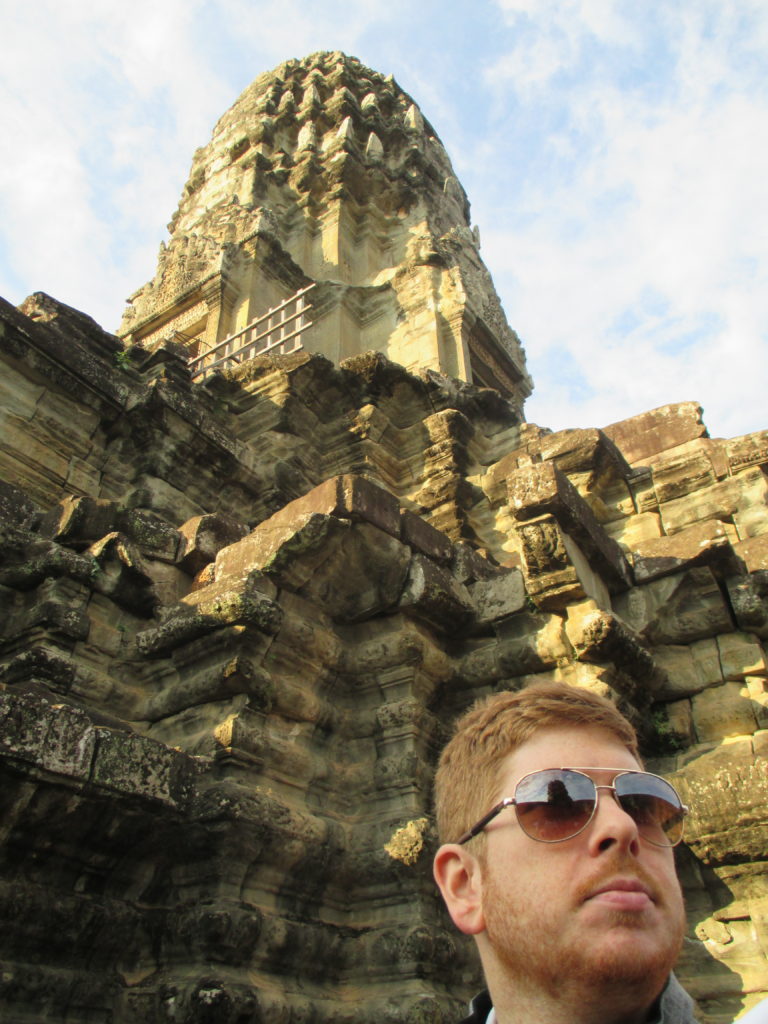
Looking up at the third story of Angkor Wat

Following many years of peace, the country erupted into a civil war once religions changed hands one-too-many times. Following this civil war was the invasion of the 57 Cambodian provinces by their neighbors Vietnam and Thailand, reducing the provinces in number to 24. At this point the king moved the capitol from here at Angkor Wat (it should be noted, this temple is just that – a temple. The king’s palace was about 2KM away) to Phnom Penh which was more accessible to the water and other resources. The temple of Angkor Wat and its surrounding temples were forgotten and lost to time for over 100 years. While Cambodia was under French rule, a Frenchman rediscovered this crumbling area. During the reign of the Khmer Rouge, many of the statues of Buddha and the Hindu gods were destroyed as they didn’t want people worshiping. Markings of this could be seen in not only the fragmented stone statues, but also in blue paint slathered here and there around the temple. Angkor Wat was designated a UNESCO world heritage site 25 years ago and is now seeing restoration work sponsored by governments around the world.

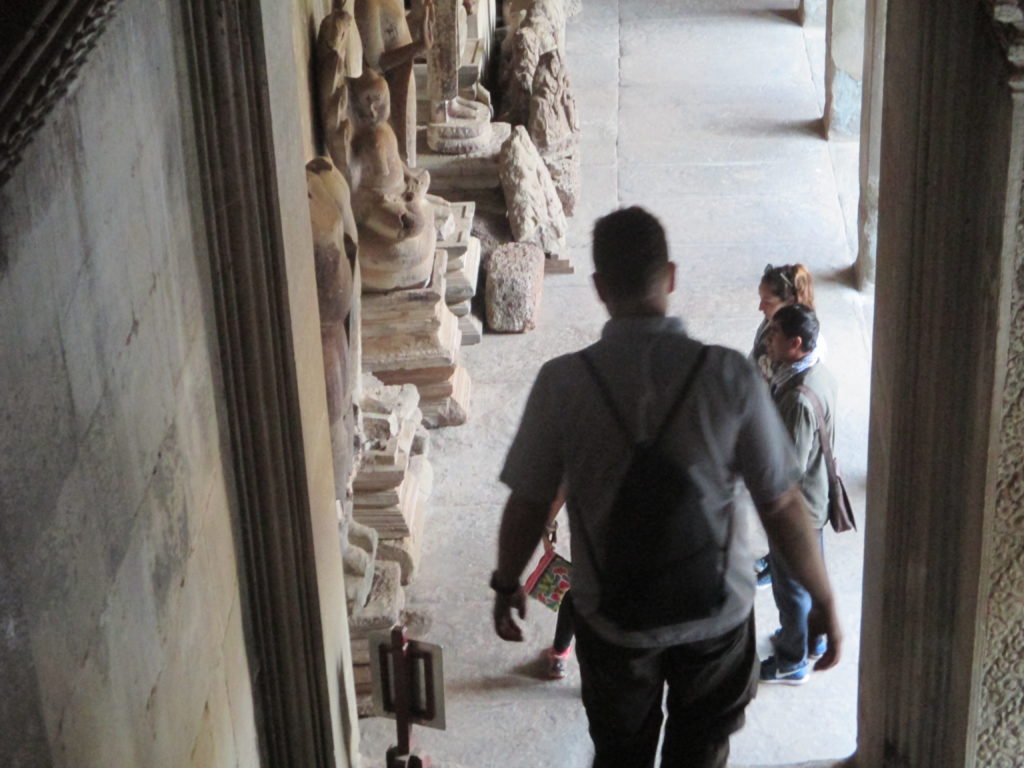
Ray entering the "1000 Buddha Gallery" where they placed all of the recovered statues after the Khmer Rouge destroyed them

Ray entering the “1000 Buddha Gallery” where they placed all of the recovered statues after the Khmer Rouge destroyed them

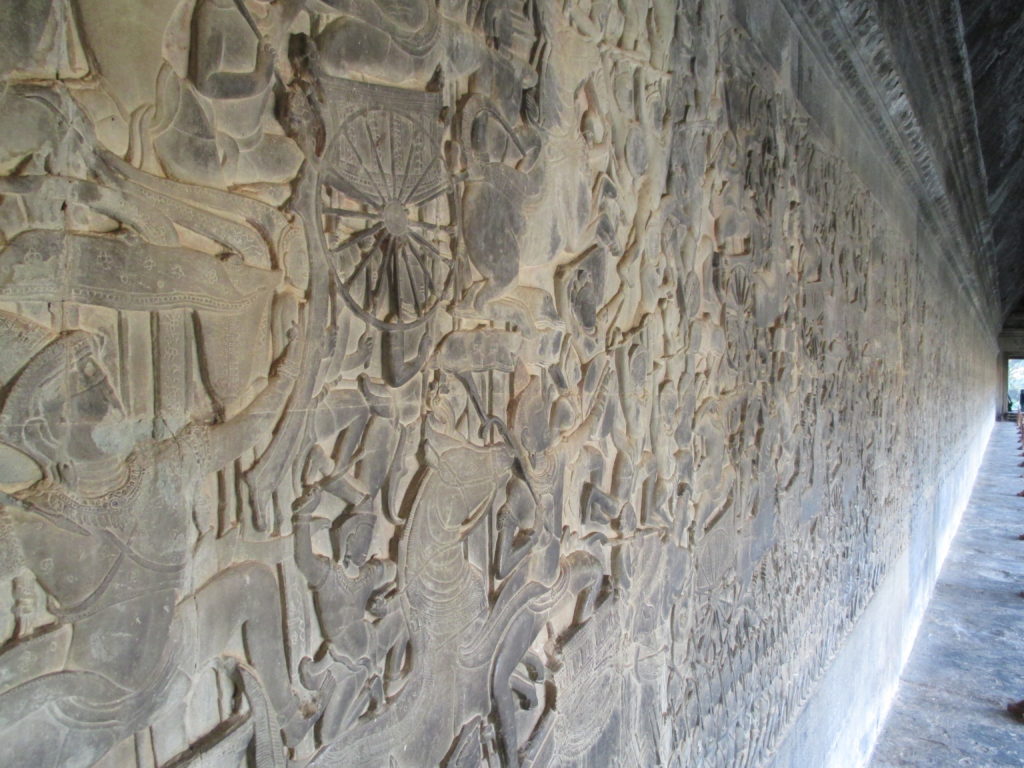
The single-most impressive element of Angkor Wat, for me, was the mind-boggling amount of intricate carvings. Carvings on every window spindle, walls upon walls of carved stories, carvings on the stairs, carvings on the roof – much of the ceiling has suffered weather damage over the years, but I imagine there were carvings there, too. Angkor Wat was built of lava stone topped with the more carve-able sandstone – both of which were either floated down the river by raft or pulled by elephants.

IMG_0548


The entire wall is carved with stories from history.

The entire wall is carved with stories from history.

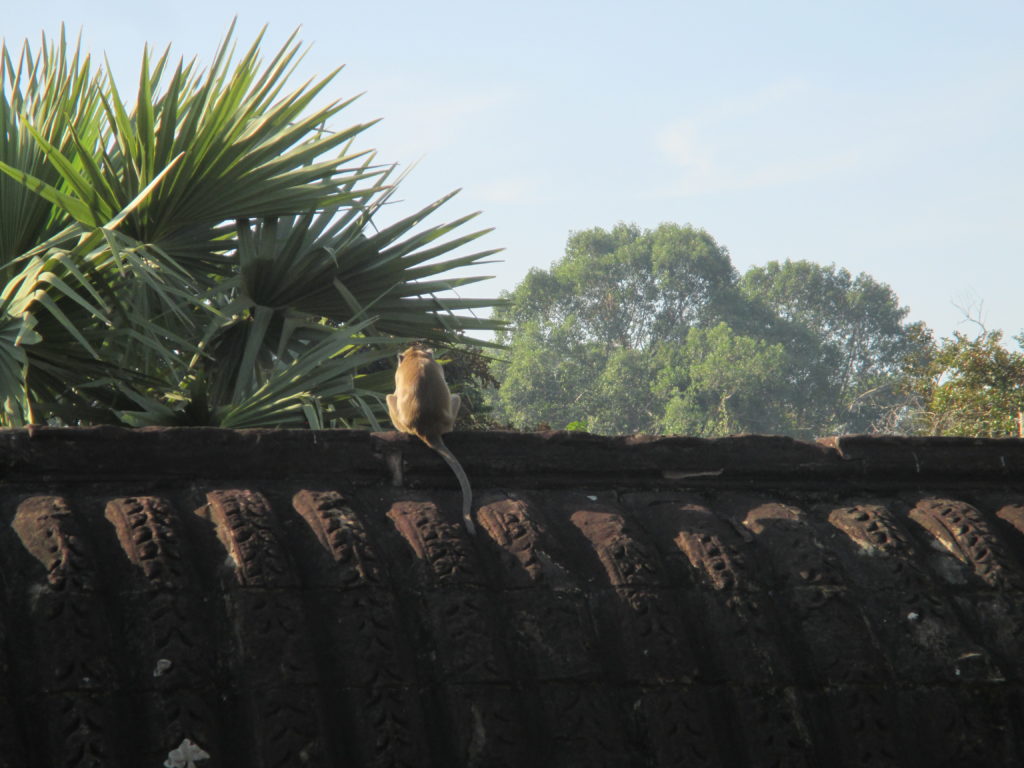
A monkey just hanging out on top of one of the rooves

A monkey just hanging out on top of one of the rooves

IMG_0572 IMG_0580

Steeeeep steps to the top

Steeeeep steps to the top

2018-01-13 08.01.15

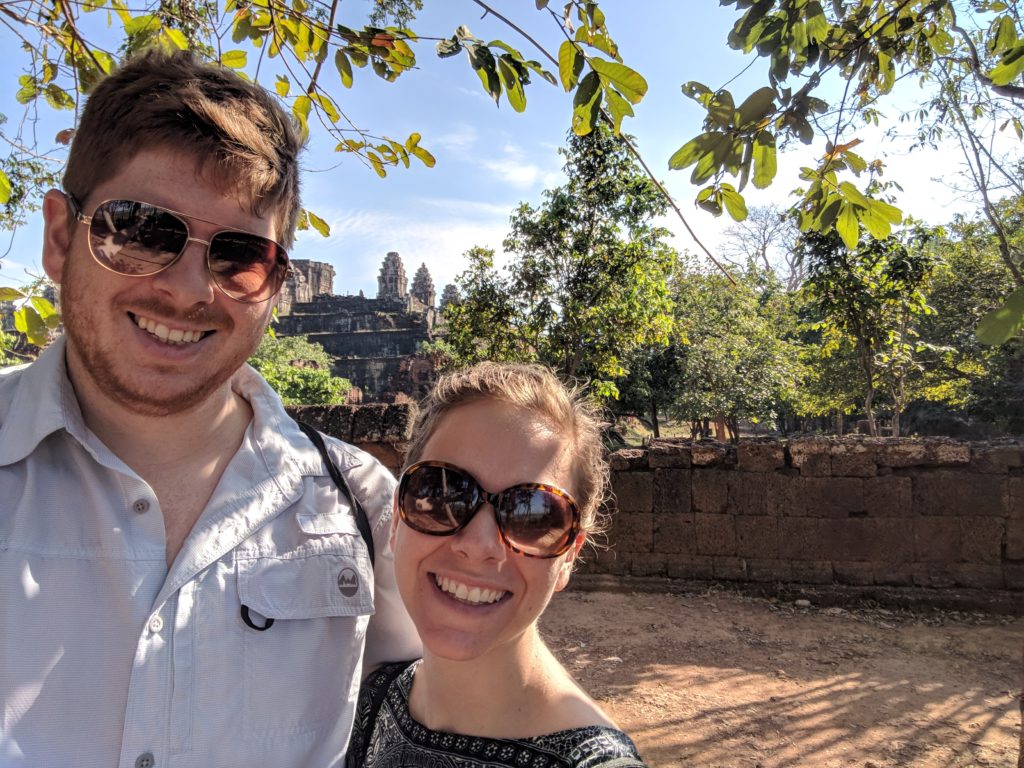
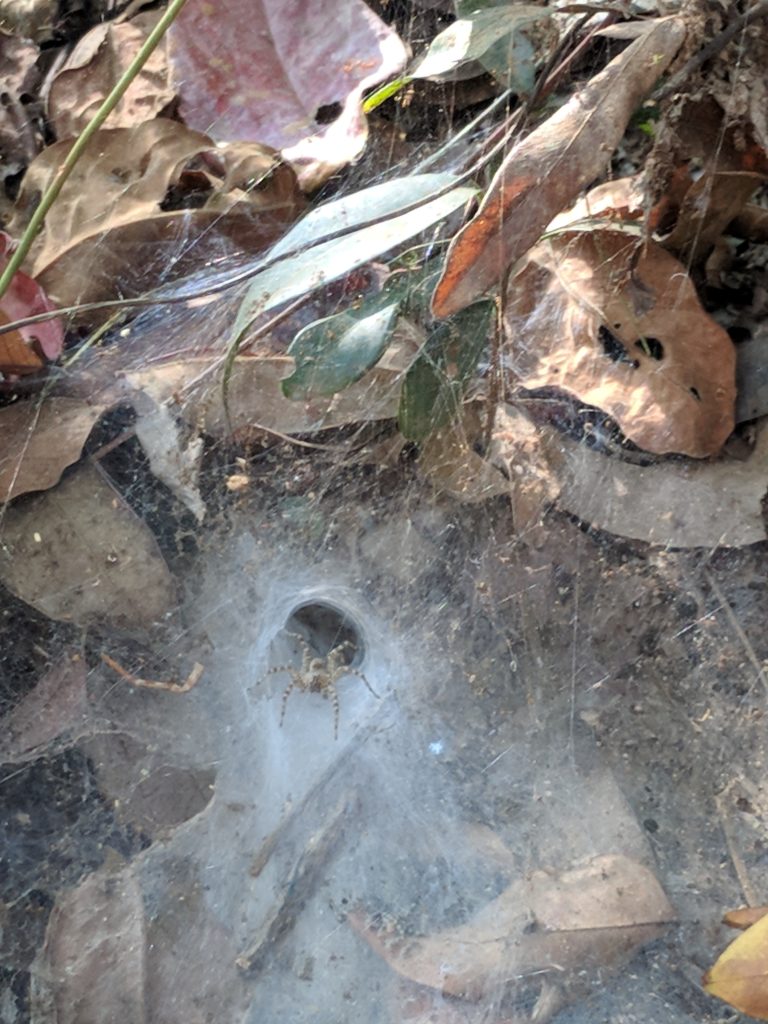
Following our visit to Angkor Wat, we headed back to our Tuk Tuk, noticing in the light all of the elements we missed in the dark. Blake drove us to Phnom Bakheng, a temple dedicated to Shiva at the top of a really lovely hike featuring unique-web-building spiders and garden lizards.

2018-01-13 09.27.39 IMG_06062018-01-13 09.36.00

Blake asked if we’d like to get some food before our next stop and we agreed. He drove us to a nearby place and we ordered some food and fruit shakes and asked him to join us which he did. We made small talk, he asked where we were going after this – Vietnam – and he told us he grew up in a rural area on the border of Vietnam. We asked if he’d ever been there and he informed us that no, in Cambodia people have to work. Just work, so they can support their families. We asked about his siblings – he has four and lives with one in Siem Reap. We asked how he learned English and he told us they teach it in school, and that his boys are also learning English – and Korean as an elective – in school. How old are your boys? 9 and 5. What do they want to be when they grow up? The older one wants to be an architect. The younger one a teacher. Have you ever brought the architect here, to Angkor Wat? No, they live at home with their mother. 400 kilometers away.

It was clear that we were from starkly different worlds. That the amount we spent on our plane ticket to our next destination alone was equivalent what he would make in a week – on a good week. That our vacation, comparatively, was sickeningly extravagant. The privilege with which we have been blindly walking, simply because of where we happened to be born was obvious.

We asked how it worked when we paid the company in Phnom Penh to secure him as our driver – how did he get paid? I don’t get paid for that trip, he said. It is a way to get in front of tourists – to get them to hire me for the day while they’re at Angkor Wat.

Do you get sick of tourists?

Yes.

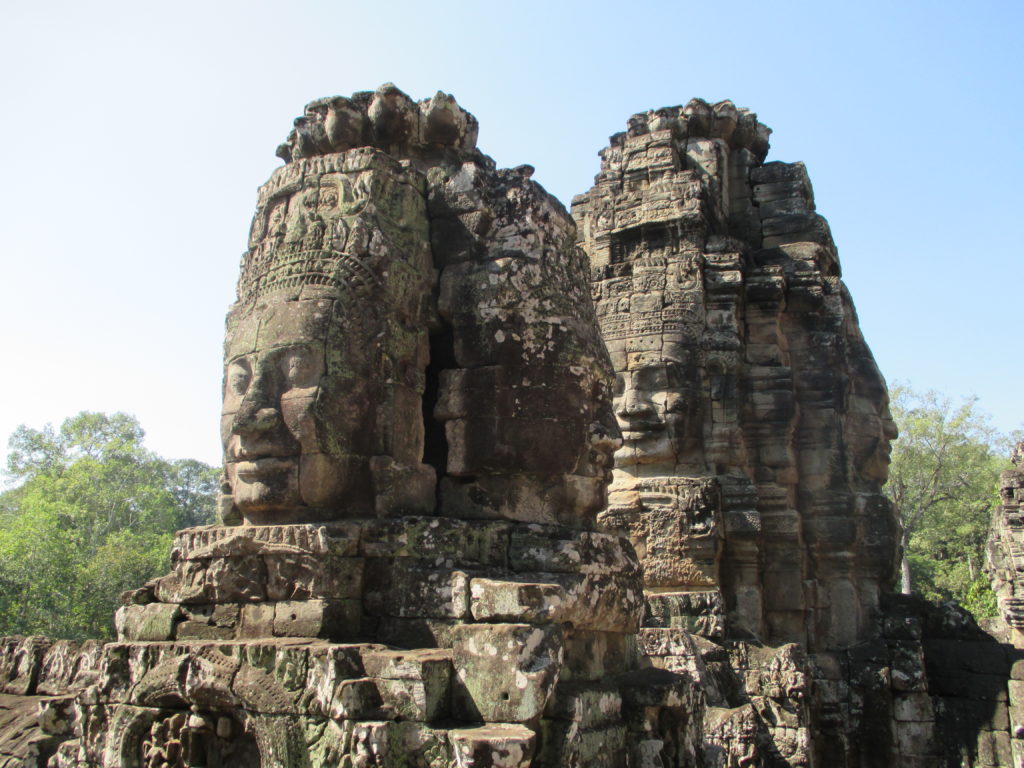
We finished our lunch and Blake brought us to Bayon, a temple within the “city” of Angkor Thom. Surrounded by beautiful, giant Khmer faces, the faces of Cambodian gods – faces that looked very much like Blake’s – I couldn’t help but think of the irony. People from all over the world come to this spot to revere the genius, ingenuity and scale of the ancient Khmer, while being carted around, waited on, and served by the modern Cambodian people in exchange for pocket change.

IMG_0622

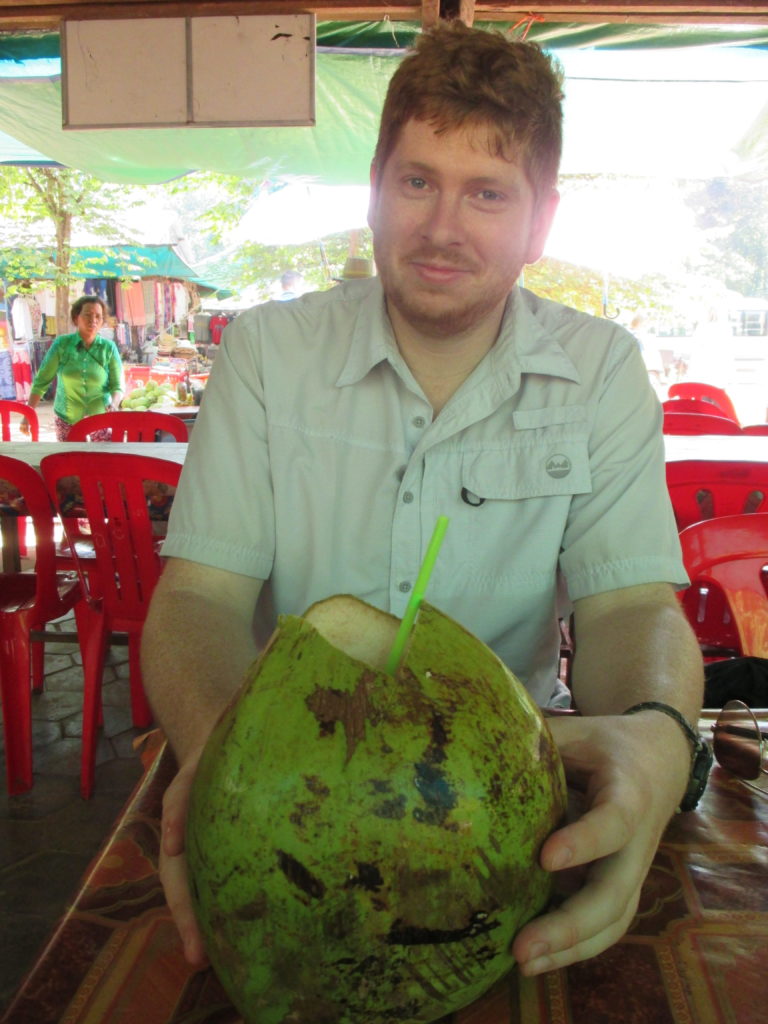
Following Blake’s instruction, we made our way to the former royal palace ruins, and other sites around Angkor Thom. He then took us to our last stop of the day, Ta Prohm. After grabbing drink from a fresh coconut, we made our way in.

IMG_0638

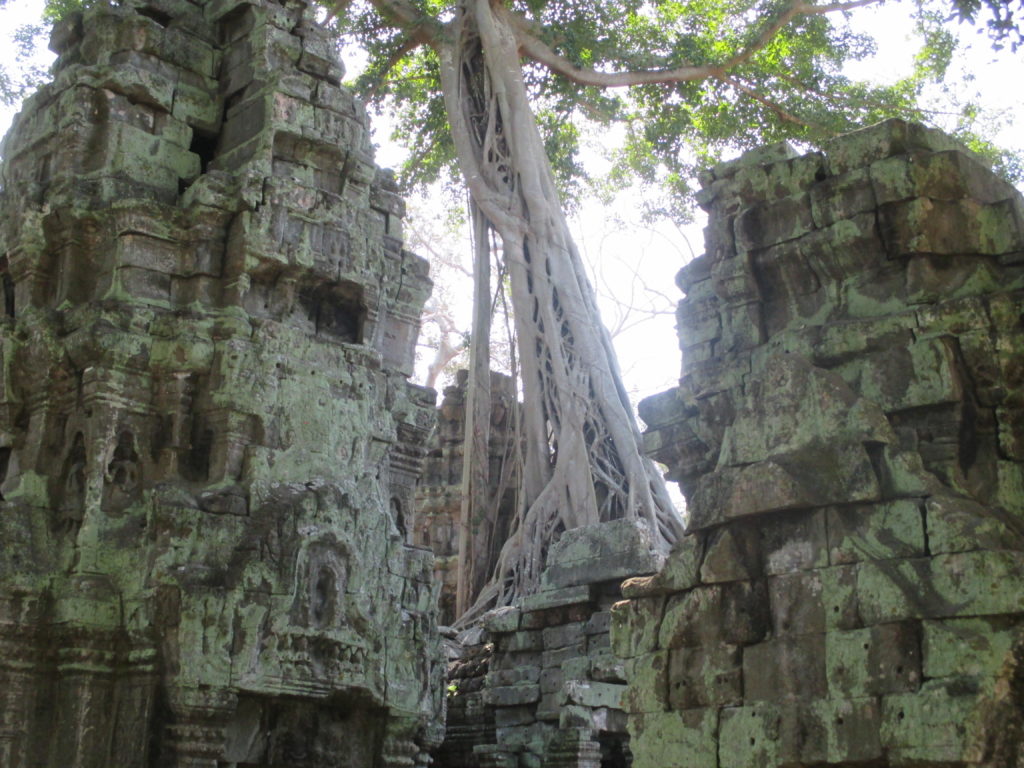
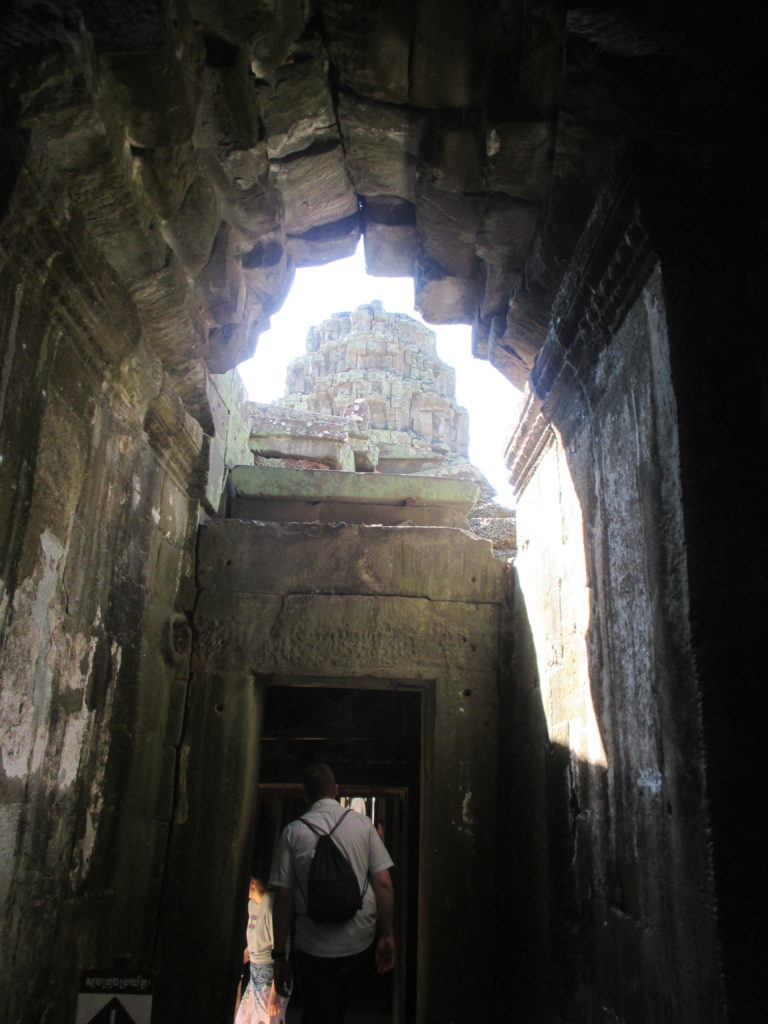
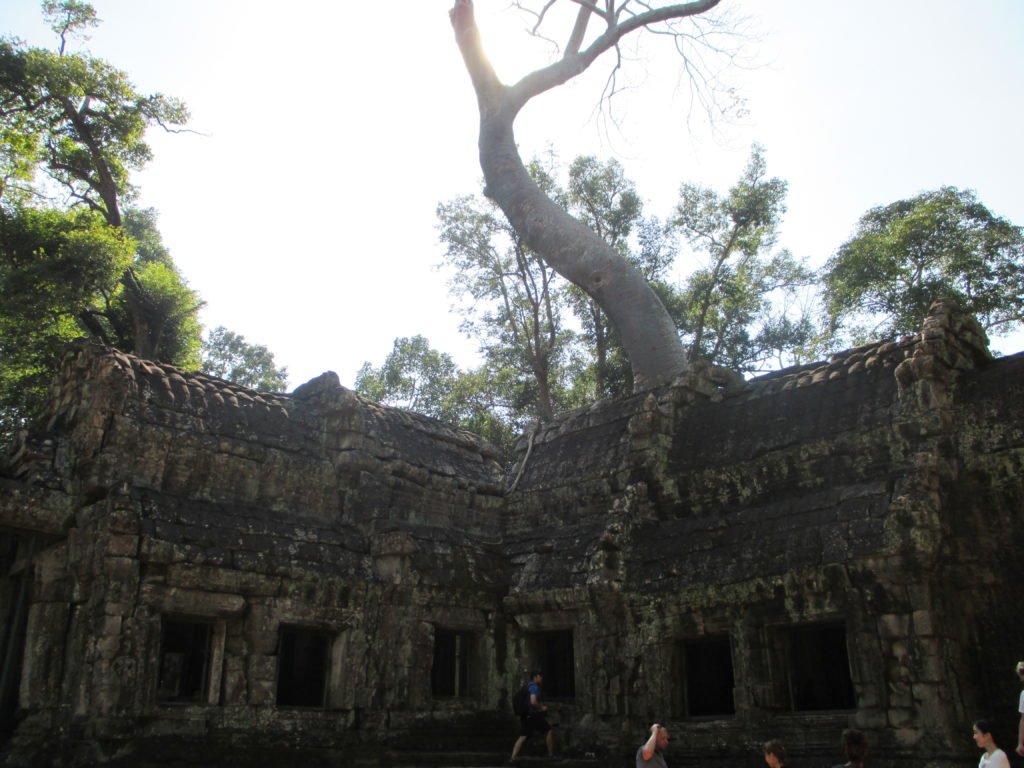
Ta Prohm was the temple I was most excited to see. Unlike the others, Ta Prohm was left as it was found by the French in the 16th century. Overgrown by giant trees, crumbling, this temple – despite the hoards of tourists – felt magical.

IMG_0653 IMG_0656 IMG_0659

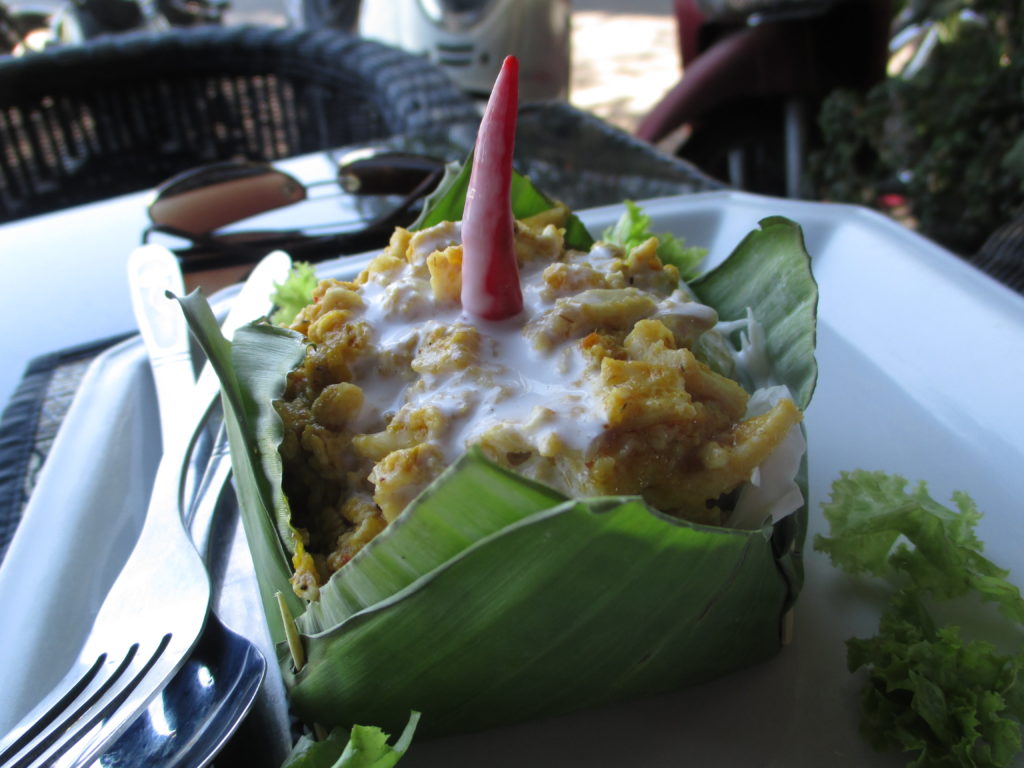
Blake took us back to our hostel where we rested and finalized our plans for tomorrow. We then took a very pleasant walk to New Leaf Cafe and ate a scrumptious dinner of Lok Lak Beef and Amok (I had to get some more before we left!) with Khmer-style iced coffee and Lemongrass iced tea. New Leaf supports local youth organizations with 30% of their profits, with 20% going to their Cambodian staff. Unfortunately, we overheard that they were closing soon, but were happy to see that, despite this, they were very busy while we were there.

1BE89EB3-9258-424A-BE8C-0C0D9BF93ECE

On our walk home we both reflected on how in love with this place we are. The people we have met in Cambodia have been some of the kindest, funniest, most welcoming and down-to-earth people we have ever met. They have been through an absurd amount of suffering at the hands of those in power (including the tourism industry). I hope, moving forward, to find ways that I can help address some of the persistent root causes of the ongoing poverty and exploitation that continues to hurt the citizens of this beautiful place.

We love you, Cambodia!

Cambodia | Day 2 – Nuggets of History

2018 Southeast Asia

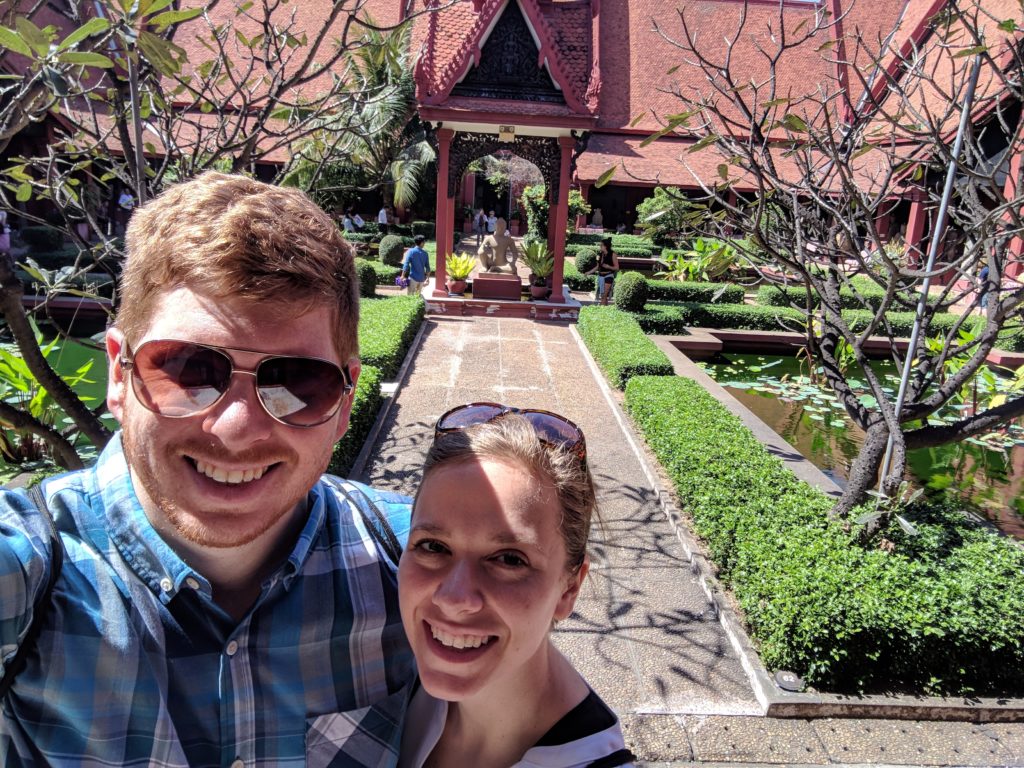
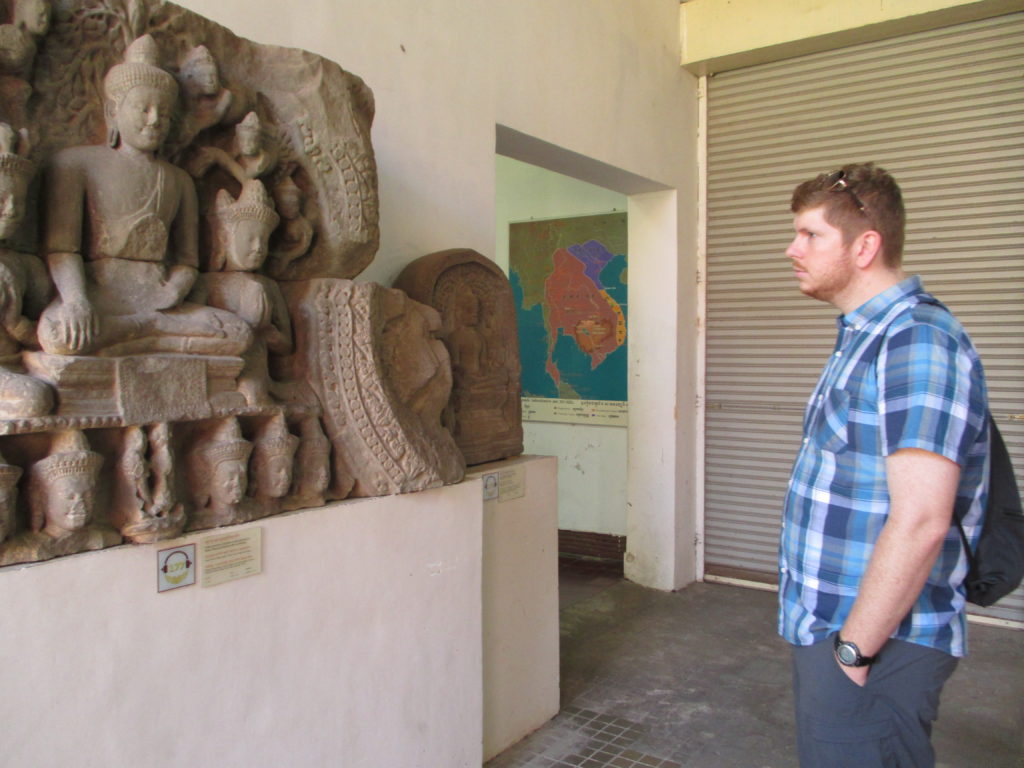
After a very restful night’s sleep, we ate a small breakfast at our hostel before taking off on foot to the National History Museum. Throughout the rather last-minute planning of this trip, I’d not gotten a chance to really dig in yet to the history of all of these places which is so important to understanding where they are at present.

2018-01-11 12.37.21

We had a very funny and sweet older woman show us around the very beautiful facility of the National History Museum. Built in 1917 and opened as a history museum in 1920 (the same year our house was built <insert head exploding emoji>), much of its contents were destroyed during the Khmer Rouge wherein anything surrounding religion was destroyed. Many items that were otherwise dislocated are just now being returned, including a set of gold jewelry which had been in a collection in the UK and was just returned in 2016.

IMG_0495

Our guide helped us better understand the history of the area, including the ebb and flow of other countries taking over in the early periods, and the importance of religion throughout the ages. While showing us a statue of Vishnu with his hand-sized wife on his arm, Ray asked “Why is she so small?” Our guide replied by just giving us a look as if to say “Well, it works for you two, doesn’t it?” She was great.

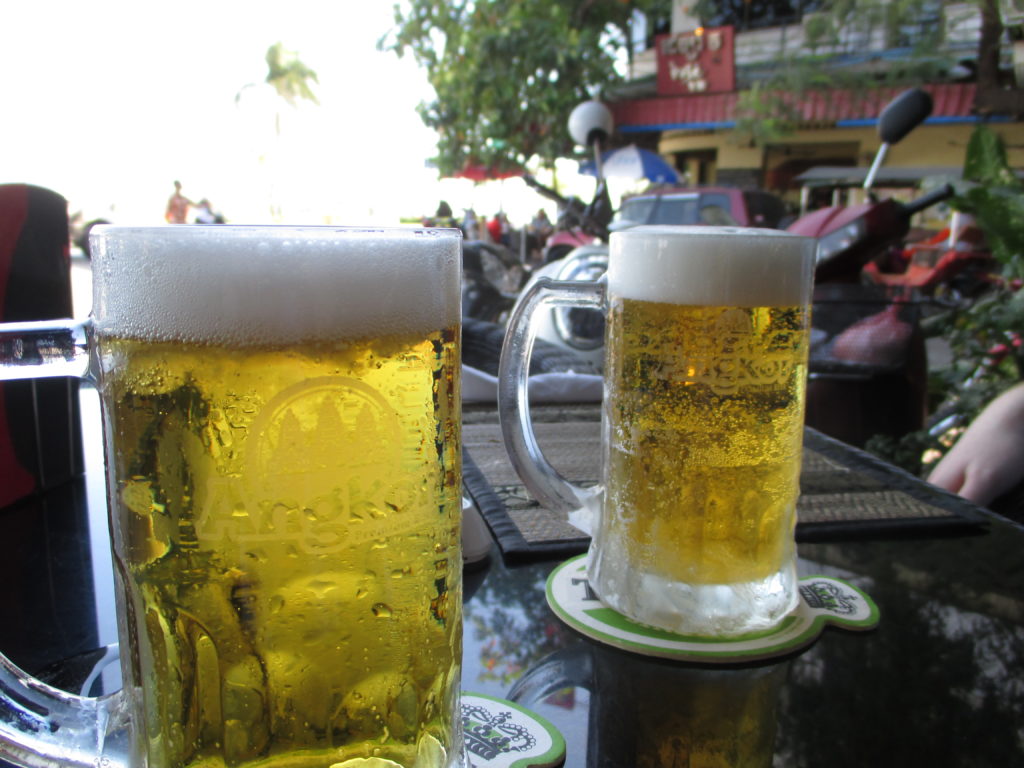
We walked back to our hostel along the broad walking lane by the river, and then stopped at a restaurant along the way that was boasting $.75 beers. How could we refuse?! 3 beers and a yummy fish amok later, we continued on our way in the hot sun.

IMG_0498 IMG_0499

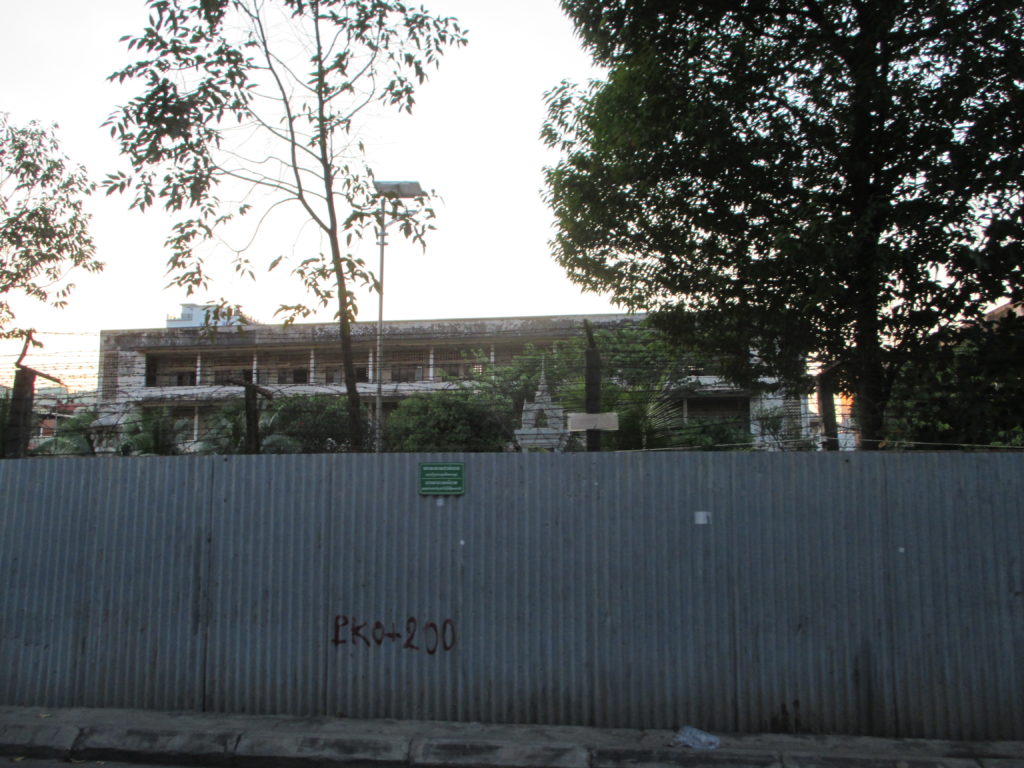
Next, we caught a tuk tuk to Tuol Sleng. This is a museum set in an old high school which was turned into a prison and place of torture during the Khmer Rouge / Pol Pot regime. This is only one of 150 or more execution centers set up in the country during this time. Again, we had a guide who took us through the harrowing museum. She told us not only of the atrocities that occurred during the 4 years the Khmer Rouge was in power (including torturing and killing members of their own party in the final days), but also of her personal story.

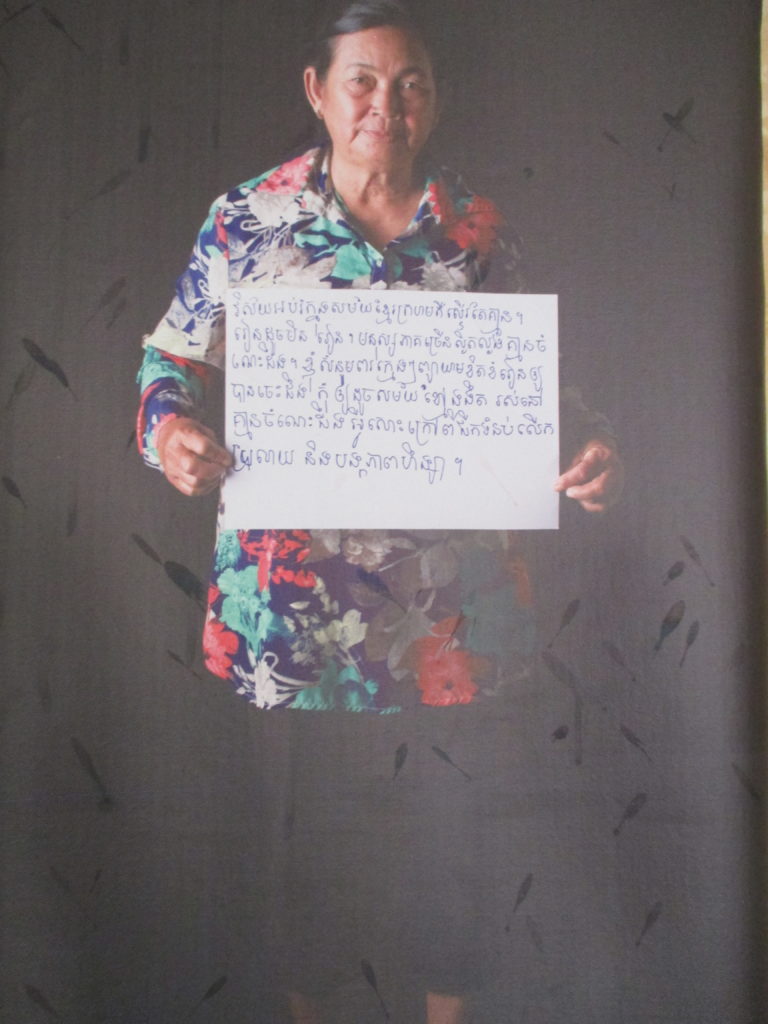
Portrait at the Museum: "Education during the Khmer Rouge period was almost none. That was the lesson, they could not educate you to learn anything. Almost everyone could not read. I suggest to the next Cambodian generations: please put more passion into learning and away from any actions that could create the dark era like that regime did when people were blinded by anger, and knew nothing besides digging canals and committing violence."

Portrait at the Museum: “Education during the Khmer Rouge period was almost none. That was the lesson, they could not educate you to learn anything. Almost everyone could not read. I suggest to the next Cambodian generations: please put more passion into learning and away from any actions that could create the dark era like that regime did when people were blinded by anger, and knew nothing besides digging canals and committing violence.”

I am currently reading First They Killed My Father, a book by Luong Ung who was 5 years old when city-dwellers were forced to leave their homes. Our guide was 9. The author of the book states at the very beginning that her story is every Cambodian’s story, and although I mentally understood what that meant, it wasn’t until I heard our guide’s startlingly similar account that I truly understood. She and her family were driven out of their home in Phnom Penh and relocated to a village in the southeastern part of Cambodia. Her father, who had been a soldier in the previous regime was killed, then her brother and sister either starved or were worked to death in a camp. Fortunately our guide and her mother were able to escape over the border into Vietnam where they lived in a refugee camp before returning to Cambodia after the fall of the Khmer Rouge in 1979.

I had expected Tuol Sleng to be really gruesome and heart-wrenching. And though it was those things, it was also very simple and matter of fact: here’s what happened. I was struck by so many things during our visit: the portraits of the impossibly young Khmer Rouge soldiers who had been “recruited” (forced to serve) from rural areas; the fact that some of the people who had governed during this period still hold positions of power today; the fact that Pol Pot was never captured or punished; that many of the higher-ups are still waiting to be put on trial. But one of the things that really struck me was that a group of maoists from Sweden, after hearing reports of the atrocities from refugees, were allowed to come in during the height of the regime (Pol Pot, despite his insistence that influence from other countries was dangerous, still needed money from outside sources). Pol Pot wined and dined them, brought them to pre-determined locations, and sent them on their way. The Swedes – this group in particular being sympathetic to the communist agenda – reported that everything was just fine! Everyone we saw was smiling! I only saw maybe four guns the whole time. This report stifled any help for the people of Cambodia from the outside world. Thankfully, the Vietnamese believed the refugees and worked to stop the regime by April 1979.

Quote from one of the exhibitions: "When the Pol Pot regime was driven from power by Vietnam in 1979, evidence of murder and execution began to be revealed to the world. Despite this, the world doubted the evidence for a considerable period of time. The perpetrators were even allowed to represent their country in the UN twelve years after the first mass graves were opened. The world has turned its eyes away a number of times during some of the 20th century's worst catastrophes: Armenia, the Nazis genocide, Rwanda, Darfur - the list goes on. Is it possible for us to learn to see sooner the next time a catastrophe is occurring?"

Quote from one of the exhibitions: “When the Pol Pot regime was driven from power by Vietnam in 1979, evidence of murder and execution began to be revealed to the world. Despite this, the world doubted the evidence for a considerable period of time. The perpetrators were even allowed to represent their country in the UN twelve years after the first mass graves were opened. The world has turned its eyes away a number of times during some of the 20th century’s worst catastrophes: Armenia, the Nazis genocide, Rwanda, Darfur – the list goes on. Is it possible for us to learn to see sooner the next time a catastrophe is occurring?”

Only seven people were found alive at Tuol Sleng when the Vietnamese arrived. One of them was an artist who, in the years following his release, took it upon himself to paint what had happened in Tuol Sleng. I was so shocked to hear that many people – many Americans – do not know (or worse yet, do not believe) what happened during this time. Knowing that, as we took our tuk tuk home, nearly everyone we passed had lost someone during that time – a quarter of the population decimated – gave me a renewed admiration and respect for the resilient Cambodian people.

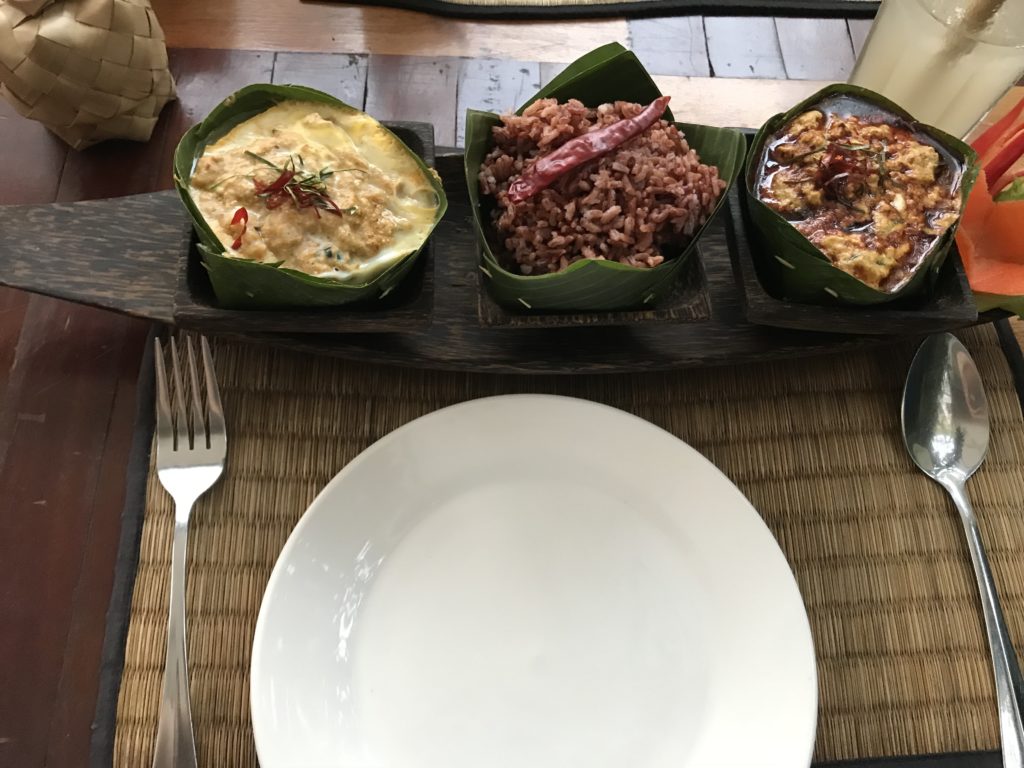
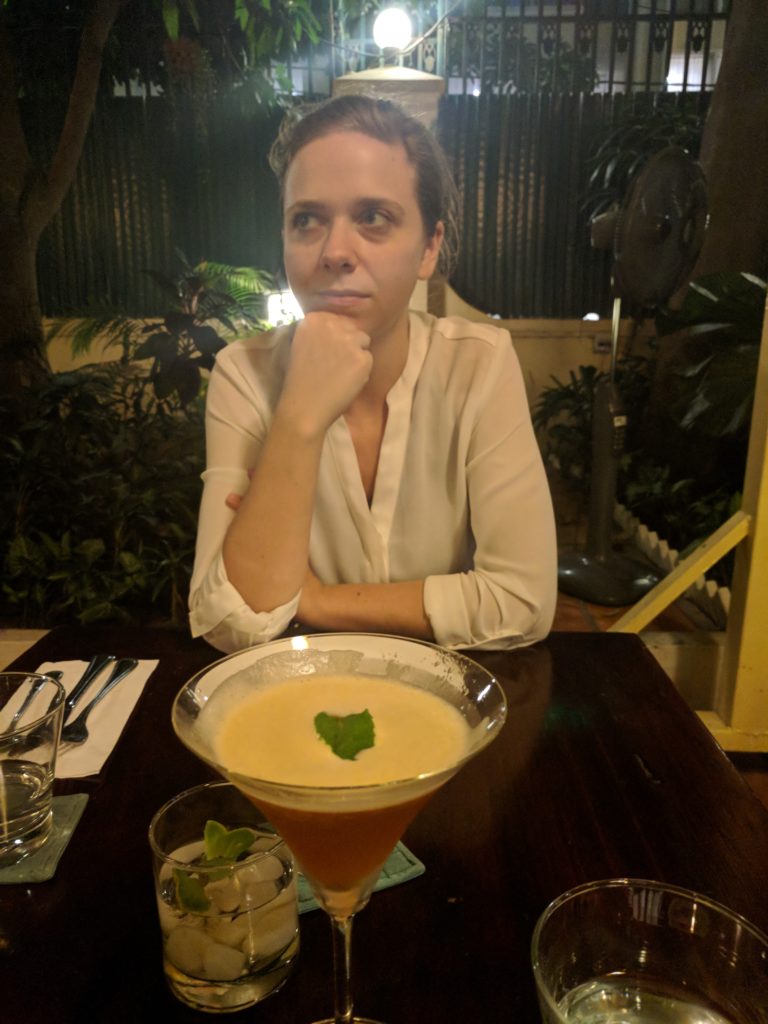
This evening we ate a most delicious dinner at Romdeng, a restaurant that trains former street children and marginalized youth to work in the hospitality industry. For drinks we had Red Tea Bourbon with Kaffir Lime (Ray) and Honey Rice Liquor with Lime, Pineapple, and Orange Juice (me). For food, we had Smoked Duck Breast Lapp with Pumpkin, Orange, Chili, and Toasted Rice (Ray) and Rice Noodle Salad with Lotus Seeds and Mushroom Coriander Spring Rolls (me) with a baguette with Lime Coriander Butter to share. It was simply wonderful.

2018-01-11 20.37.07

Now we are in our comfy dorm getting everything packed for our early-morning boat ride to Siem Reap!